In This Article
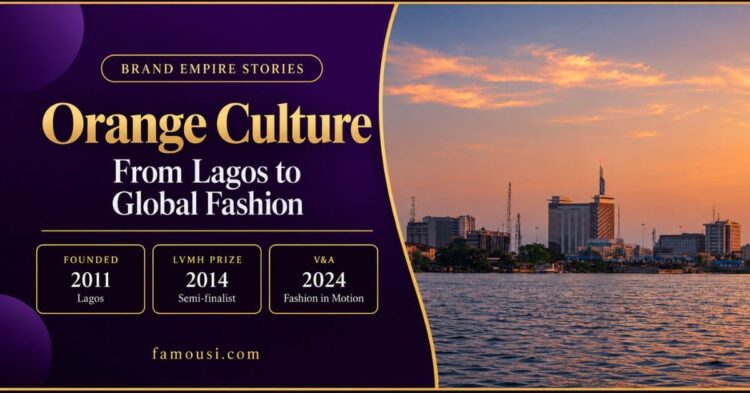
Orange Culture’s history is not simply the story of a Nigerian label gaining international attention. Since Adebayo Oke-Lawal launched the brand in Lagos in 2011, Orange Culture has built its identity around a more difficult proposition: using fashion to question conventional ideas about masculinity, gender and African style while still building a business capable of reaching customers beyond Nigeria.
That combination helps explain why the label’s most important milestones are so different from one another. A 2014 LVMH Prize semi-final put Orange Culture on an international fashion stage. A 2024 presentation at London’s Victoria and Albert Museum placed its work inside a major cultural institution. More recently, the company has changed how it sells, putting greater emphasis on direct-to-consumer business after Oke-Lawal described problems with the wholesale model.
Orange Culture’s Brand-Building Timeline
| Year / period | Verified turning point | What changed | Why it matters |
|---|---|---|---|
| 2011 | Orange Culture launches in Lagos under Adebayo Oke-Lawal | A distinct Nigerian fashion label begins to take shape | Establishes Lagos, the founder and the original creative identity |
| 2014 | Orange Culture becomes an LVMH Prize semi-finalist | The label receives international industry recognition | Creates an early bridge between a Lagos label and a global fashion audience |
| Post-2014 | International stockists and shows expand its visibility | Orange Culture appears through retailers and fashion events outside Nigeria | Moves the brand beyond domestic recognition without proving standalone sales growth |
| 2021 | Oke-Lawal begins splitting his time between Lagos and London | International customer access becomes a more deliberate business priority | Shows the company adapting operations as its audience becomes more global |
| 2024 | Orange Culture appears in V&A Fashion in Motion | The brand enters a major museum fashion program | Adds institutional and cultural visibility to its commercial fashion story |
| 2025–2026 | The business emphasizes DTC while the label continues showing internationally | Distribution strategy and creative expansion evolve together | Shows Orange Culture changing how it reaches customers without abandoning its Lagos identity |
The chronology is supported by the LVMH Prize’s Orange Culture profile, the V&A’s Fashion in Motion record and Vogue Business’s 2025 interview with Oke-Lawal.
Orange Culture began with a point of view, not just a product category
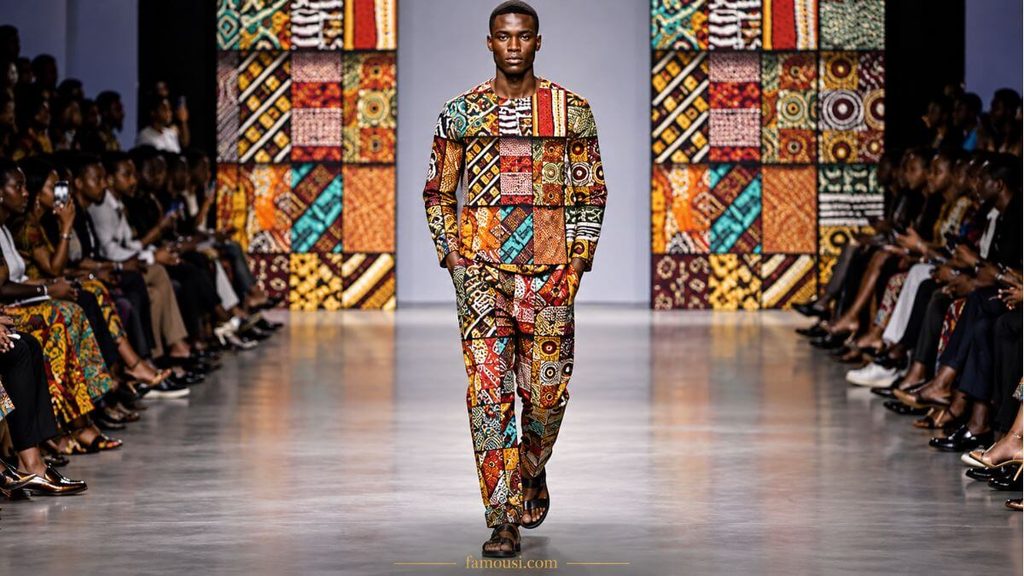
The brand’s own description makes its intended role unusually explicit. Orange Culture says it challenges traditional ideas of gendered fashion, combining Nigerian and wider African references with contemporary silhouettes while questioning the signals attached to masculine dress. The company describes clothing as fluid rather than restricted to rigid gender categories.
That philosophy is visible in earlier independent documentation too. The LVMH Prize described Oke-Lawal’s work as mixing Nigerian-inspired silhouettes and printed fabrics with contemporary urban streetwear. The important point is not that the brand found one signature item and repeated it. Its more durable code has been an attitude toward silhouette, colour, masculinity and African identity.
This makes Orange Culture different from brands whose history can be explained primarily through one object. Famousi’s Prada Re-Nylon story shows how a material such as nylon can become a reusable brand code. Orange Culture’s recognizable system is less object-specific: it comes from how Oke-Lawal repeatedly translates identity, memory and social questions into clothing.
The 2014 LVMH recognition was an early international turning point
One frequently repeated detail about Orange Culture needs careful wording.
The primary LVMH Prize record identifies Adebayo Oke-Lawal and Orange Culture as a semi-finalist of the 2014 LVMH Prize. Some later coverage has described the label as a finalist, but the LVMH page is the stronger source for the prize’s own classification, so “semi-finalist” is the more precise description.
The milestone still matters without exaggerating it. Vogue Business reports that after the LVMH recognition, Orange Culture secured stockists including Browns and Farfetch and showed collections in fashion centres including Paris, London and New York, as well as at Pitti Uomo in Florence. Orange Culture declined to give the publication sales figures, so those appearances demonstrate growing visibility rather than proving a particular level of revenue or market share.
That distinction is central to understanding the brand’s rise. International attention can create access, credibility and new audiences, but it does not automatically make the economics of an independent fashion company easy.
Lagos remained part of the brand even as its audience became more international
In 2021, Oke-Lawal began dividing his time between Lagos and London. He told Vogue Business that the move was part of an effort to make the business more accessible to customers around the world while continuing to describe Nigeria as home.
The creative work reflects that tension between movement and rootedness.
Vogue’s review of Orange Culture’s Lagos Spring 2025 collection described a collection shaped by Oke-Lawal’s experiences of leaving Lagos and moving to London, including the feelings of nostalgia and displacement that can accompany migration. Rather than treating international expansion as a reason to neutralize its identity, Orange Culture used that movement itself as material for design.
The same pattern would become visible in one of the brand’s clearest institutional milestones.
The V&A gave Orange Culture a different kind of international visibility
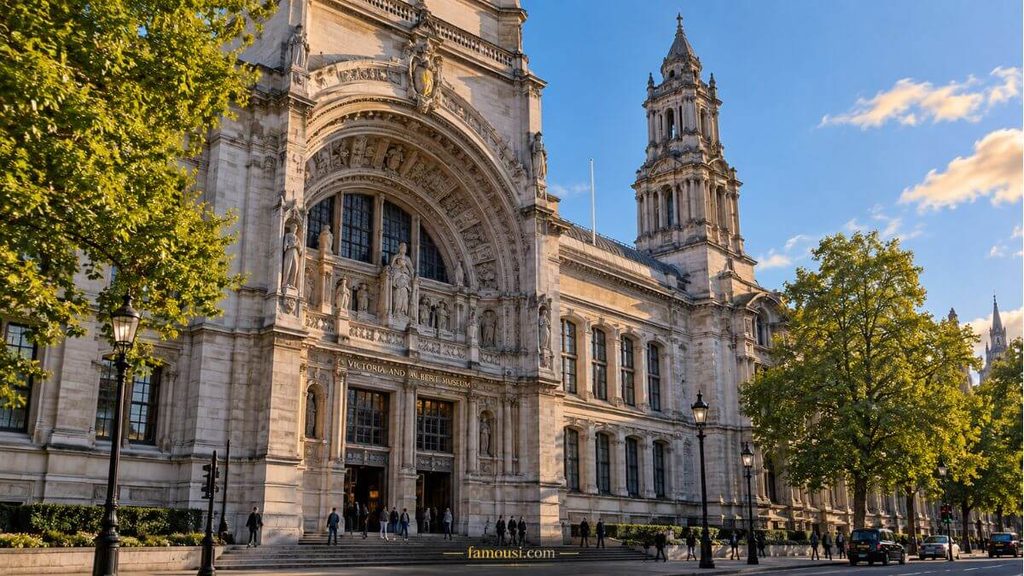
On August 16, 2024, Orange Culture appeared at V&A South Kensington as part of the museum’s Fashion in Motion series. The V&A described the Nigeria-based label as creating contemporary androgynous clothing and said the presentation addressed identity, belonging and sustainability.
The collection presented there focused on migration and the effort to create a sense of home in a new place. The V&A’s editorial feature on Orange Culture connects the work to Oke-Lawal’s memories of childhood gardens and to the mixture of difficulty, nostalgia and community that can shape migration.
That matters because the V&A appearance did something different from a retail placement or fashion-week slot. It positioned Orange Culture’s clothing as part of a broader discussion about design, culture and identity.
For a brand that had described itself as a movement years earlier, the museum presentation was consistent with its original ambition rather than a completely new direction.
International recognition did not remove the business problem
The less glamorous part of Orange Culture’s story is the question of how an independent label converts recognition into a sustainable operating model.
Vogue Business reported in October 2025 that Oke-Lawal had become increasingly cautious about wholesale. He cited unpaid invoices and large unit requirements as reasons the company had decided to focus more heavily on selling directly to customers.
The publication reported that wholesale had previously represented approximately 60% of sales and DTC 40%, while Oke-Lawal said the DTC share had since reached 100%. These are company- or founder-reported figures in the October 2025 interview, not independently audited financial statements, and they should be understood in that context.
The strategic importance is clearer than the numbers alone. Earlier in Orange Culture’s development, international retailers represented access to customers the label could not easily reach itself. Later, a stronger direct relationship with customers gave Oke-Lawal more freedom to decide whether a wholesale relationship made business sense.
That is not a rejection of international expansion. It is a change in the route used to pursue it.
The 2026 collections show that global expansion has not erased the Nigerian production story
Orange Culture’s international runway presence continued in 2026.
Vogue’s review of the Fall 2026 Berlin collection, Backyards of Memory, described a collection built around Oke-Lawal’s childhood memories and his relationship with his late mother. More importantly for the brand’s operating story, Vogue reported that Orange Culture’s pieces were made in Nigeria from locally sourced fabrics and that the season included collaborations with Lagos-based creative businesses and artisans.
Those details matter because international expansion often creates pressure for independent brands to make themselves visually or operationally more generic.
Orange Culture’s recent work points in the opposite direction: Berlin provides an international stage, but the design references, production and collaborations continue to pull the story back toward Nigeria.
It would be too strong to claim that one collection proves a permanent production rule for every Orange Culture product. What it does establish is that the Nigerian creative ecosystem remained materially present in the brand’s 2026 work.
Orange Culture’s real evolution is the relationship between identity and access
A simple version of Orange Culture’s history would say that a Lagos designer gained recognition abroad.
The stronger explanation is that the company repeatedly changed the mechanism of access without abandoning the underlying point of view.
The LVMH Prize created one kind of access: industry recognition. International retail and fashion weeks created another: distribution and visibility. London gave Oke-Lawal a practical base closer to international customers. The V&A created cultural visibility. Direct-to-consumer sales reduced some of the brand’s dependence on wholesale partners.
Across those changes, the recurring creative language—fluid silhouettes, Nigerian references, colour, questions around masculinity and personal storytelling—remained recognizable.
That relationship between a stable identity and changing routes to the audience is one of the most useful ways to understand Orange Culture’s development.
Frequently Asked Questions
Who founded Orange Culture and when was it launched?
Adebayo Oke-Lawal founded Orange Culture in Lagos. The LVMH Prize and Vogue Business date the label’s launch to 2011, which is the date used for this history. Orange Culture’s current About page uses the wording “2010/2011,” so readers may encounter both formulations in official material.
What is Orange Culture known for?
Orange Culture is known for fashion that combines Nigerian and broader African references with contemporary, fluid and androgynous silhouettes. The brand explicitly says it challenges traditional ideas about gendered clothing, while the V&A has described its work in terms of identity, belonging and socially aware storytelling.
Was Orange Culture a finalist for the LVMH Prize?
The LVMH Prize’s own archive identifies Orange Culture as a semi-finalist in 2014. Some later publications have used “finalist,” but the primary LVMH record supports “semi-finalist,” so that is the more precise description.
Did Orange Culture show at the V&A?
Yes. Orange Culture participated in the V&A’s Fashion in Motion program at V&A South Kensington on August 16, 2024. The presentation focused on themes including migration, identity, belonging and the process of creating a sense of home in a new place.
Why did Orange Culture shift toward direct-to-consumer sales?
Adebayo Oke-Lawal told Vogue Business in October 2025 that Orange Culture had chosen to focus on direct-to-consumer sales after experiencing problems with wholesale, including unpaid invoices and large unit requirements. The publication reported that the business had previously been roughly 60% wholesale and 40% DTC, while the DTC share had later reached 100%; those figures are reported from the company/designer rather than independently audited financial data.
From Lagos label to a brand designed to last
Orange Culture’s most important achievement is not that it followed a standard path from local label to global brand. Its history suggests almost the opposite.
Adebayo Oke-Lawal built a recognizable creative position first, then repeatedly adapted how that position reached people. International prizes, retailers, fashion weeks, a museum presentation, a second working base in London and a stronger direct-to-consumer model each solved a different problem.
The result is a brand that can appear in London or Berlin without making Lagos irrelevant.
That does not prove what Orange Culture’s future scale will be. It does show why the brand has remained distinctive through more than a decade of changing fashion-industry conditions: the routes to the audience have changed more than the reason the brand exists.