In This Article
Calvin Klein did not become a global fashion name by endlessly reinventing its identity. Its more distinctive achievement was almost the opposite: taking a remarkably restrained design language and applying it again and again to products people already understood.
From the label’s 1968 New York beginnings to designer denim, logo-waistband underwear and decades of provocative advertising, Calvin Klein learned how to turn simplicity into recognition. Under PVH ownership, the business has expanded far beyond its founder, yet minimalism, denim, underwear and culturally visible storytelling remain central to how the brand presents itself.
That continuity helps explain why Calvin Klein history is more than a timeline of collections. It is a story about making everyday categories carry a powerful identity.
Calvin Klein’s Key Brand Turning Points
| Period | Verified turning point | Why it matters to the brand story | Evidence qualification |
|---|---|---|---|
| 1968 | Calvin Klein Limited was founded in New York by Calvin Klein with business partner Barry Schwartz | Established the New York fashion business that would become the Calvin Klein brand | Historical founding evidence |
| 1980 | The Brooke Shields jeans campaign became a major advertising and cultural flashpoint | Showed how product and provocative communication could reinforce each other | Historical campaign context |
| 1981 | Calvin Klein’s current Cotton Classics line dates its original men’s underwear style to 1981 and identifies the logo waistband as a defining feature | The waistband turned branding into a visible part of an everyday garment | Applies specifically to the product lineage described by Calvin Klein |
| 2003 | PVH acquired Calvin Klein | Ownership moved from the founder-era company into a larger global fashion group | Corporate ownership milestone |
| 2025 | Calvin Klein Collection returned to New York Fashion Week with Veronica Leoni’s debut Collection | Re-established Collection as a high-fashion expression of the brand’s minimalist heritage | Current-company record |
| 2025 scale | PVH says global retail sales of Calvin Klein products were approximately $9 billion | Demonstrates the present commercial scale of the Calvin Klein name | Company-reported global retail sales, not PVH accounting revenue |
The Calvin Klein story began with restraint, not excess
Calvin Klein Limited was founded in New York in 1968 by Calvin Klein with the backing of his childhood friend and business partner Barry Schwartz. The Smithsonian’s National Museum of American History traces the company to those beginnings and describes Klein as a designer particularly associated with minimalism, jeans, underwear and controversial advertising.
That combination is important because the early Calvin Klein aesthetic was unusually transferable.
Clean lines and reduced forms could work in tailoring, but the same idea could also be applied to denim, underwear, fragrance, accessories and home products. Instead of requiring every new category to invent a different visual personality, the brand could make different products feel connected.
Minimalism therefore became more than a fashion preference. It became a system.
Denim moved Calvin Klein from designer fashion toward everyday culture
Jeans were one of the clearest demonstrations of that system.
The Council of Fashion Designers of America credits Calvin Klein with pioneering designer jeans and describes his work as combining clean lines, spare shapes and a modern sense of simplicity.
Denim mattered because it brought designer identity into an everyday garment with enormous cultural reach. Calvin Klein did not need to make jeans unfamiliar to make them desirable. The opportunity was to attach a strong fashion point of view to something consumers already knew.
Advertising intensified that effect.
In 1980, a Brooke Shields jeans campaign became one of the most controversial episodes in the brand’s history. The Smithsonian documents both the campaign and the debate it generated. The significance was not simply that the advertisements attracted attention. They helped make the relationship between Calvin Klein, denim, sensuality and cultural conversation difficult to separate.
That pattern would recur throughout the brand’s development: relatively simple products surrounded by extremely memorable image-making.
Underwear turned the logo itself into part of the product
Underwear pushed the strategy even further.
Calvin Klein’s current Cotton Classics product description says its original men’s underwear style was first introduced in 1981 and identifies the original Calvin Klein logo waistband as one of its defining features.
That date needs a precise qualification. The evidence supports the lineage Calvin Klein currently describes for Cotton Classics; it should not be stretched into a claim that every Calvin Klein underwear product or format began in exactly the same year.
The larger design idea is easier to see.
A waistband ordinarily performs a functional job. Calvin Klein turned it into a visible brand surface. The garment could remain visually simple while the repeated name supplied recognition.
That was especially effective for a brand already built around reduction. Calvin Klein did not have to cover a product in decoration for it to become identifiable. A restrained garment and a highly recognizable wordmark could do the work together.
The mechanism is different from Prada’s use of an unconventional material, but the underlying branding lesson is comparable: an ordinary component can become a durable house code when it is repeated with enough consistency. Famousi explores that transformation in how Prada turned nylon into Re-Nylon.
Calvin Klein advertising made restraint feel provocative
It would be misleading to say advertising alone built Calvin Klein. Denim and underwear had to be products consumers wanted, and the brand’s minimalist aesthetic had to be recognizable before communication could reinforce it.
But advertising changed the emotional temperature around that simplicity.
Calvin Klein repeatedly placed reduced clothing and prominent branding inside images designed to create conversation. The contrast was powerful: the products could look simple while the communication around them felt bold, intimate or confrontational.
The CFDA notes both Klein’s minimalist design influence and his willingness to court controversy in advertising. Taken together with the Smithsonian’s historical record, the evidence suggests a brand system in which product restraint and high-impact communication strengthened one another.
That distinction matters. The ads were not a substitute for design. They made a clear design identity more culturally visible.
PVH ownership changed the company without erasing its core codes
A major structural change came in 2003, when PVH acquired Calvin Klein.
The current PVH Calvin Klein profile still describes the brand through simplicity and sensual minimalism and presents underwear and denim as core parts of its product world. PVH also reports that global retail sales of Calvin Klein products reached approximately $9 billion in 2025.
That number needs context.
The approximately $9 billion figure is global retail sales of Calvin Klein products. It is not the same measure as revenue recorded by PVH.
PVH’s 2026 SEC-filed proxy materials report $3.964 billion in 2025 Calvin Klein revenue. The filing also reports $3.857 billion for 2024.
Those figures describe different economic scopes, so they should not be added together or treated as competing estimates. The retail-sales number describes sales of Calvin Klein products at retail; the PVH figure is the company’s brand-level accounting revenue.
The broader point is simpler: Calvin Klein now operates at a scale far beyond the founder-era label while retaining several of the same recognizable brand codes.
Fashion ownership can produce very different structures. For comparison, Famousi’s analysis of Armani’s post-founder ownership shows a model centered on a foundation, ownership rights and succession rather than acquisition by a global fashion group.
The modern Calvin Klein is deliberately returning to its archive
One of the clearest signs that Calvin Klein still sees its history as strategically useful came with the return of Calvin Klein Collection.
In February 2025, Veronica Leoni presented her debut Fall 2025 Collection as Calvin Klein returned to New York Fashion Week. PVH described the Collection as rooted in the brand’s DNA and centered on what it called “monumental minimalism.” The Fall 2025 Collection announcement explicitly connected Leoni’s work with the founder’s original approach.
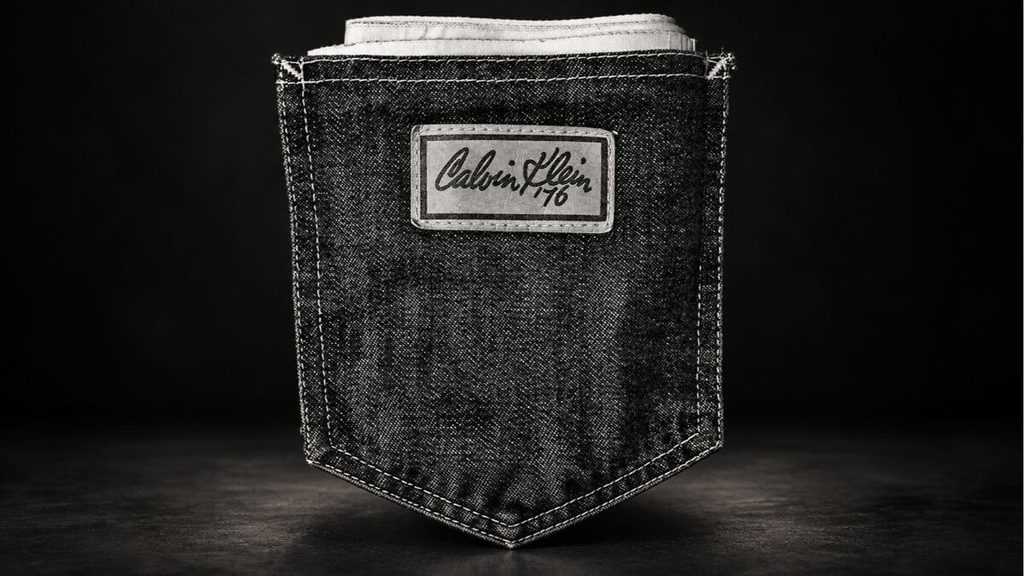
The connection became even more literal in Fall 2026, when Collection revisited denim from the Calvin Klein archive dating to 1976.
And the story is still current. In September 2026, Calvin Klein presented Veronica Leoni’s Spring 2027 Collection in New York, describing it as a continuing exploration of American Minimalism. The Spring 2027 Collection announcement again centered reduction, foundational garments and the relationship between clothing and the body.
That does not mean today’s Calvin Klein is simply recreating the past. It means the company continues to treat its historical design vocabulary as usable material rather than museum history.
Why Calvin Klein’s brand system endured
Calvin Klein’s history suggests that a fashion brand does not always need the most complicated product to create the strongest identity.
The company repeatedly found ways to make basic categories carry more meaning: jeans became designer denim, a waistband became a visible logo, minimal clothing became the foundation for provocative imagery, and a restrained New York aesthetic became applicable across a global lifestyle business.
There were major changes in ownership, leadership, distribution and scale along the way. Yet the most recognizable parts of the brand story have remained unusually consistent.
That consistency may be the most useful explanation for Calvin Klein’s longevity. The brand evolved, but it rarely needed to abandon the visual language that made it recognizable in the first place.

Frequently Asked Questions
When was Calvin Klein founded, and who founded it?
Calvin Klein Limited was founded in New York in 1968 by designer Calvin Klein with his childhood friend and business partner Barry Schwartz. The company later expanded from its original fashion business into categories including denim, underwear, fragrance, accessories and home.
How did Calvin Klein become famous?
Calvin Klein became famous through a combination of minimalist fashion design, designer denim, underwear and highly visible advertising. The CFDA credits Klein with pioneering designer jeans and redefining underwear, while Smithsonian historical material documents how the 1980 Brooke Shields jeans campaign intensified the brand’s cultural visibility. No single factor alone explains the brand’s later global scale.
When did Calvin Klein introduce its iconic underwear?
Calvin Klein’s current Cotton Classics product page says its original men’s underwear style was first introduced in 1981 and identifies the original Calvin Klein logo waistband as a defining feature. That date should be understood as evidence for the product lineage described by Calvin Klein, not as proof that every Calvin Klein underwear style began in 1981.
Who owns Calvin Klein today?
Calvin Klein is owned by PVH Corp., which acquired the company in 2003. PVH remains the corporate owner as of September 2026 and operates Calvin Klein alongside Tommy Hilfiger as one of its principal global brands.
How big is Calvin Klein today?
PVH says global retail sales of Calvin Klein products were approximately $9 billion in 2025. Separately, PVH’s SEC-filed 2026 proxy materials report $3.964 billion in 2025 Calvin Klein revenue. The figures measure different things: global retail sales and PVH’s reported brand revenue should not be treated as the same metric.
Calvin Klein’s history is really a story about making simplicity recognizable
Calvin Klein began as a New York fashion business in 1968, but its most durable achievement was building a visual identity that could survive changes in product category, ownership and generation.
Denim broadened the audience. Underwear transformed a logo into part of the garment. Advertising gave minimal products an unusually strong cultural presence. PVH supplied a different corporate structure and global scale. And today’s Collection is again working with the vocabulary of reduction and American minimalism that made the brand recognizable decades ago.
The details changed. The underlying idea proved much harder to replace.