
In This Article
Last reviewed: August 25, 2026
Armani is not simply “owned by the Armani family” after Giorgio Armani’s death. The succession structure separates legal ownership, usufruct rights, voting power and day-to-day management.
Under Giorgio Armani’s will, the Giorgio Armani Foundation sits at the center of the ownership structure. The will gives it full ownership of 9.9% of Giorgio Armani S.p.A. and bare ownership of another 90%; reporting on the succession notes that the Foundation already held the remaining 0.1%. Usufruct rights over that 90% are assigned to Giorgio Armani’s long-time associate Pantaleo “Leo” Dell’Orco and four family members. Voting power is divided differently again.
That distinction is the key to answering who owns Armani now.
Who controls Armani now?
| Party | Position under the succession structure | Voting rights | What that means |
|---|---|---|---|
| Giorgio Armani Foundation | Full ownership of 9.9% transferred by the will, plus bare ownership of 90%; the Foundation already held 0.1% | 30% | Legal ownership and long-term governance anchor |
| Pantaleo “Leo” Dell’Orco | Usufruct over 30% of the shares | 40% | Largest individual voting bloc |
| Silvana Armani | Usufruct over 15% | 15% | Family beneficiary with voting power |
| Andrea Camerana | Usufruct over 15% | 15% | Family beneficiary with voting power |
| Roberta Armani | Usufruct over 15% | 0% | Economic/usufruct interest without voting rights |
| Rosanna Armani | Usufruct over 15% | 0% | Economic/usufruct interest without voting rights |
The published will distinguishes bare ownership from usufruct. In other words, simply listing percentages beside each beneficiary can give the wrong impression that all of those percentages represent ordinary outright ownership. They do not. The Foundation holds the underlying bare ownership of the 90%, while the named beneficiaries receive usufruct rights over those shares.

The Giorgio Armani Foundation is the legal anchor
The Foundation was not created after Giorgio Armani’s death as an emergency succession vehicle. Armani established it in 2016, years before the transition became immediate.
Armani’s own governance page explains that the Foundation was created to provide continuity in the company’s future management and to preserve the principles that shaped the founder’s creative and entrepreneurial work. Those principles include autonomy, independence, innovation, product excellence and prudent financial management.
That history matters because the Foundation’s role goes beyond receiving shares. The structure was designed to give an institution tied to Giorgio Armani’s stated principles a permanent place in the company’s governance.
The succession therefore looks less like a conventional family inheritance and more like a system of checks, voting rights and long-term stewardship.
Voting power tells a different story from ownership
The clearest example is Leo Dell’Orco.
Dell’Orco has usufruct over 30% of the shares, but 40% of Armani’s voting rights under the initial post-succession structure. The Giorgio Armani Foundation has 30% of the votes. Together, Dell’Orco and the Foundation therefore command 70% of voting rights before the planned outside investment changes the structure.
Silvana Armani and Andrea Camerana each have 15% of voting rights. Roberta Armani and Rosanna Armani hold usufruct interests but no voting rights under the structure established by the will.
This is why “Who inherited Armani?” and “Who controls Armani?” are not the same question.
The Foundation is the central legal ownership vehicle. Dell’Orco is the largest individual voting force. Selected family members retain significant rights. None of those facts, by itself, fully describes who controls the company.
Management is separate again
Ownership and voting power also should not be confused with day-to-day executive management.
Giuseppe Marsocci was appointed Chief Executive Officer of Giorgio Armani in October 2025. He had spent more than two decades with the company and previously served as Global Chief Commercial Officer. His appointment placed an experienced internal executive at the head of operations while the Foundation, Dell’Orco and other stakeholders oversee the broader succession structure.
The distinction is important: Marsocci manages the company as CEO, but that does not mean he owns or controls Armani’s shares.
It also illustrates Giorgio Armani’s broader succession design. Creative continuity, corporate management, legal ownership and shareholder voting were not handed to one replacement figure.
The planned 15% Armani stake sale has not been completed
The most important unresolved part of the succession is the entry of an outside shareholder.
Giorgio Armani instructed the Foundation to sell an initial 15% stake and named LVMH, L’Oréal and EssilorLuxottica as preferred potential buyers. The will also allows another comparable fashion or luxury company to be selected under the conditions it establishes.
That does not mean any of the three preferred groups currently owns 15% of Armani.
The latest high-authority update found during this review is the Reuters report published on August 11, 2026. It said the process remained at an early stage and could extend beyond the March 2027 timetable associated with the founder’s instructions. Armani did not announce a completed buyer in that report.
For readers following the transaction, that distinction is essential: a preferred buyer is not an owner, negotiations are not a completed sale, and a succession instruction is not evidence that a transaction has already closed.
The first 15% sale may only be the beginning
The will sets out a broader path beyond the initial minority investment.
After the first transaction, it provides for a further transfer to the same buyer within the later succession period, or alternatively a stock-market listing. At the same time, Giorgio Armani’s instructions preserve a substantial permanent role for the Foundation; Reuters reported that the Foundation is to retain at least 30.1% under the eventual structure.
That makes the intended direction clearer even though the final shareholder list is not yet known.
Armani is moving from the highly centralized founder-led model that defined the company for decades toward a structure in which the Foundation provides continuity, trusted insiders retain influence, professional management runs the business and an outside strategic shareholder may eventually enter.
What remains unknown is which outside investor will join, on what terms and when.
What the succession structure means for the Armani brand
Giorgio Armani spent decades keeping unusually close control over both the creative and business sides of the company. His succession plan does not attempt to reproduce that concentration of authority in one heir.
Instead, it divides responsibility.
The Foundation protects the long-term governance framework. Dell’Orco carries the largest individual voting position. Family members retain defined roles. Marsocci leads the company operationally. A future strategic shareholder may add another layer without eliminating the Foundation’s role.
That structure may be more complicated than a simple inheritance, but the complexity appears deliberate: the founder separated different types of power rather than leaving the entire business dependent on one successor.
Readers exploring more global fashion and brand coverage can also browse Famousi’s Fashion & Style section.

Frequently Asked Questions
1. Who owns Armani now after Giorgio Armani’s death?
The Giorgio Armani Foundation is the central legal ownership vehicle. Giorgio Armani’s will transferred full ownership of 9.9% of Giorgio Armani S.p.A. to the Foundation and bare ownership of another 90%, while usufruct rights over that 90% were assigned to Leo Dell’Orco and four Armani family members. The Foundation also already held 0.1%. Voting rights are allocated separately.
2. Does the Giorgio Armani Foundation own Armani?
Yes, but the answer needs qualification. The Foundation holds full ownership over roughly 10% when its pre-existing stake is included and bare ownership over the other 90%. The beneficiaries named in the will have usufruct rights over that 90%. The Foundation therefore occupies the central legal ownership position without holding all of the economic and voting rights by itself.
3. Who controls Armani’s voting rights?
Under the initial post-succession structure, Leo Dell’Orco has 40% of voting rights and the Giorgio Armani Foundation has 30%, giving them 70% combined. Silvana Armani and Andrea Camerana each hold 15%. Roberta Armani and Rosanna Armani have no voting rights under that structure. These are voting percentages, not equivalent outright ownership percentages.
4. Is Armani being sold to LVMH, L’Oréal or EssilorLuxottica?
Giorgio Armani’s will identifies LVMH, L’Oréal and EssilorLuxottica as preferred potential buyers for an initial 15% stake, but none was established as the completed buyer in the latest high-authority reporting reviewed on August 25, 2026. Reuters reported on August 11 that the process remained preliminary and could extend into 2027.
5. Who is the CEO of Armani now?
Giuseppe Marsocci is CEO of Giorgio Armani. He was appointed in October 2025 after more than two decades with the group. His executive role should be distinguished from ownership: Marsocci manages the company, while the Foundation, Dell’Orco and other beneficiaries hold the ownership, usufruct and voting rights created by the succession structure.
The Armani succession is about more than inheritance
The simplest answer to “Who owns Armani?” is the Giorgio Armani Foundation—but the accurate answer goes further.
The Foundation anchors legal ownership, Dell’Orco and the Foundation dominate the initial voting structure, family beneficiaries hold defined usufruct and voting rights, Marsocci leads day-to-day management, and a future investor may ultimately take a significant stake.
Until that outside transaction is completed, any claim that LVMH, L’Oréal, EssilorLuxottica or another company already owns the planned stake goes beyond the verified evidence.
Featured Image
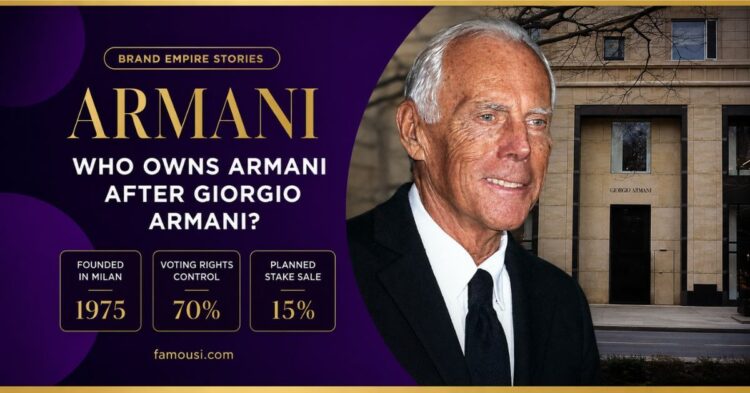
Giorgio Armani reference photography by Bruno Cordioli via Wikimedia Commons, licensed under CC BY 2.0; Armani building reference photography by Dimitris Kamaras via Wikimedia Commons, licensed under CC BY 2.0. Adapted and composited for Famousi using AI-assisted image production.
Editorial Image 1
Giorgio Armani reference photography by Bruno Cordioli via Wikimedia Commons, licensed under CC BY 2.0. Adapted for Famousi using AI-assisted image production.
Editorial Image 2
Armani building reference photography by Dimitris Kamaras via Wikimedia Commons, licensed under CC BY 2.0. Adapted for Famousi using AI-assisted image production.