In This Article
Victoria Beckham’s brand story is more useful when it is read as an 18-year business transformation rather than a celebrity-to-designer shortcut.
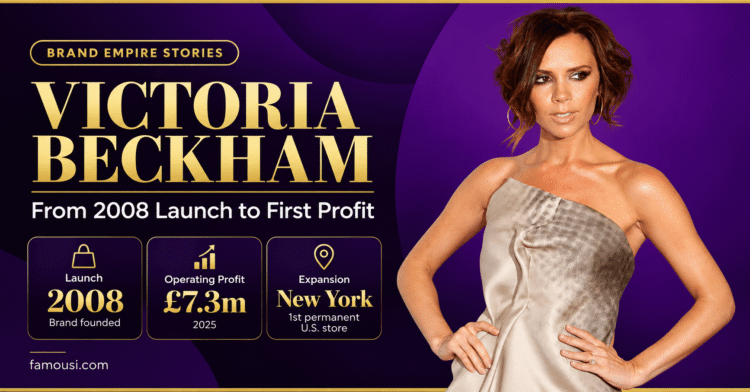
The label began in 2008 with a small collection of dresses. By 2025, the wider fashion-and-beauty business had recorded its first operating profit: £7.3 million on £129.8 million in revenue, according to Reuters. Revenue was up 15% for the year.
That milestone did not arrive through one viral product or one dramatic relaunch. The more revealing story is how Beckham kept adding the pieces required to turn personal recognition into a luxury business: a clearer fashion identity, physical retail, new categories, beauty, stronger distribution and, eventually, a business able to report an operating profit.
Victoria Beckham’s brand turnaround at a glance
| Year | Turning point | What changed | Why it matters |
|---|---|---|---|
| 2008 | Victoria Beckham launches her eponymous label | The business begins with a collection of dresses focused on cut and fit | Establishes fashion design—not licensing—as the foundation of the label |
| 2014 | Dover Street flagship opens in London | The brand gains a permanent retail environment of its own | Gives Beckham more control over how the label is physically presented |
| 2019 | Victoria Beckham Beauty launches | Beckham expands into a separate but connected beauty business | Extends her design identity beyond clothing into a repeat-purchase category |
| 2025 | First operating profit | The fashion-and-beauty business reports £7.3m operating profit and £129.8m revenue | Marks the clearest verified financial turning point in the story |
| 2026 | First permanent U.S. store opens in New York | A boutique opens at 150 Mercer Street in SoHo | Adds another direct retail platform after profitability was reached |
The timeline matters because each step changed something structural. The brand did not simply become more famous; it became capable of doing more things under Victoria Beckham’s name.
The fashion business started with a deliberately narrow idea
Victoria Beckham’s official company history dates the label to 2008 and says it began with dresses celebrated for their cut and fit. Today, the fashion offering extends across ready-to-wear, footwear, eyewear and leather goods. Victoria Beckham’s official brand history also says that, as of October 2026, the label is carried in 230 stores across 50 countries.
That origin matters because Beckham already had worldwide name recognition. The easier commercial route would have been to treat the name itself as the product. Instead, the company had to establish whether a Victoria Beckham label could develop a recognizable fashion language independent of her earlier career.
The early focus on dresses gave the brand a relatively contained design problem to solve. From there, the challenge became expansion without turning the business into a collection of unrelated categories.
That same tension appears in many long-lived fashion businesses. Famousi’s history of Fendi’s century of reinvention shows a different house using recognizable people, products and place to maintain continuity while its organization changed. Victoria Beckham’s history is much shorter, but the strategic question is similar: what remains recognizable as the business grows?
A flagship store made the brand more than a wholesale label
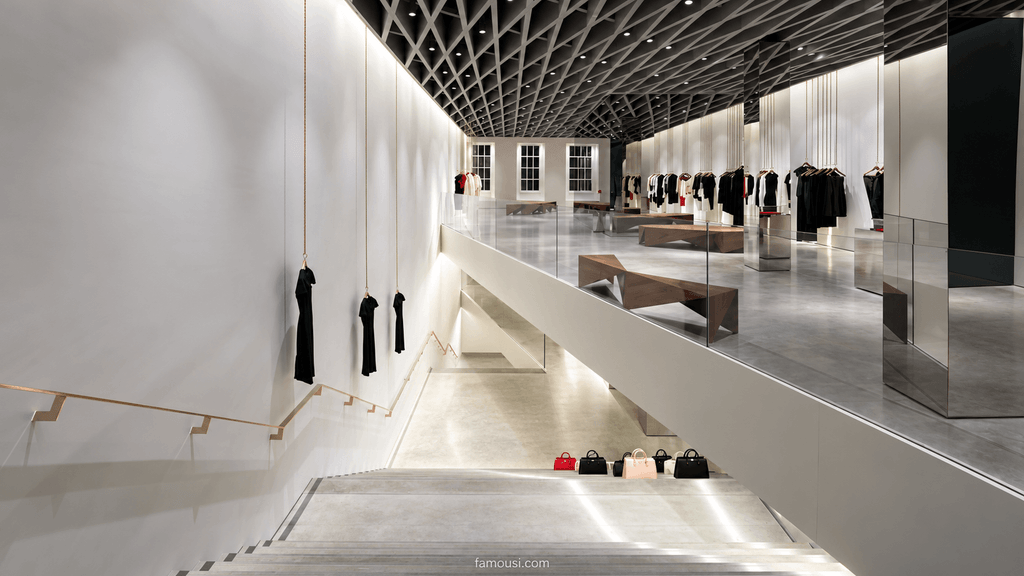
The 2014 opening of the Dover Street flagship in London was an important step because physical retail gave Victoria Beckham a controlled setting for the brand.
Wholesale can put a designer in front of more customers, but the retailer decides which products to buy, how much space they receive and what sits beside them. A dedicated store gives the label more authority over assortment, styling, architecture and customer experience.
That distinction became especially visible in 2026, when Beckham opened her first permanent U.S. boutique at 150 Mercer Street in New York. Speaking to Vogue about the New York store, Beckham emphasized the value of controlling the store’s own buy rather than having a wholesale partner make the selection.
The New York opening therefore makes more sense as part of a longer retail story than as an isolated expansion headline. London established a permanent branded environment; New York extends that approach into another major luxury market.
Beauty gave the Victoria Beckham name a second operating system
Victoria Beckham Beauty launched in 2019 as a separate but connected beauty business. Contemporary Vogue reporting described it as an in-house brand rather than another short-term licensed celebrity collaboration.
That distinction is important.
Fashion and beauty behave differently. Clothing depends heavily on seasonal collections, sizing, inventory and higher-ticket purchasing decisions. Beauty can create a broader rhythm of repeatable products across makeup, skincare and fragrance.
The current Victoria Beckham Beauty operation shows how far that second platform has developed. Its official site spans makeup, skincare and fragrance, while The Foundation Drops with TFC8® currently comes in 19 shades. Victoria Beckham Beauty’s Foundation Drops page documents the current range.
Beauty should not, however, be turned into an unsupported explanation for everything that followed. Public evidence supports the conclusion that beauty became an important additional part of the business. It does not establish that one beauty launch, product or category single-handedly caused the company to become profitable.
That boundary makes the turnaround more interesting, not less. The story is about a system becoming broader and more functional rather than one miracle product arriving at the right moment.
The 2025 profit is a turning point, not the whole story
The most important recent financial milestone came in 2025.
Reuters reported in October 2026 that Victoria Beckham’s fashion-and-beauty business made its first profit in 2025, with £7.3 million in operating profit and revenue rising 15% to £129.8 million. The report describes the business as spanning fashion, leather goods, makeup and perfume.
That scope matters. The £129.8 million figure should not be presented as revenue from the fashion label alone, nor should the £7.3 million be described as a standalone profit figure for one category.
The milestone is more useful when it is treated as evidence that a long restructuring and expansion process finally reached a measurable point of financial progress.
It also places earlier reports about the brand’s struggles in a different context. In 2022, Vogue described a company being reorganized around profitability, new leather goods, geographic expansion and a stronger management structure. Four years later, the first operating profit provides a verified outcome against which that earlier strategy can be viewed.
That does not prove which individual decision contributed most. It does show that the company moved from talking about a route toward profitability to reporting one.
New York suggests the business is still moving outward
Profitability could have encouraged the company to consolidate. Instead, 2026 has included a notable physical expansion.
The SoHo boutique became Victoria Beckham’s first permanent U.S. store in September 2026. It joined the London flagship while giving the company another location in which it can control the assortment and presentation directly.
The timing is significant because it comes after the 2025 financial milestone rather than before it.
The company also remains active at the highest level of the fashion calendar. On October 2, 2026, Beckham presented her Spring/Summer 2027 collection at Paris Fashion Week. Reuters’ coverage of the show paired the runway news with the company’s new profitability and New York expansion, showing how the creative and business stories are currently developing together.
The brand is therefore not best understood as a turnaround that has already ended. It has reached a new phase in which the question becomes whether profitability, category breadth and direct retail can be sustained together.
Reinvention also changed how the Victoria Beckham name is understood
Victoria Beckham started the fashion business with an unusual advantage and an unusual problem: almost everyone already knew who she was.
Recognition created attention, but it also created skepticism. A famous name could bring people to the first collection; it could not by itself establish a long-term fashion house.
That tension is now part of Beckham’s public narrative. Netflix’s three-part 2025 documentary follows her transition from pop fame into fashion and her preparation for a major Paris Fashion Week show. Netflix’s official Victoria Beckham documentary page frames the series around reinvention rather than presenting the fashion business as an automatic extension of celebrity.
The useful business lesson is not that celebrity is irrelevant. Beckham’s existing audience was clearly an asset. The more defensible conclusion is that attention and durable business value are different things.
The Victoria Beckham story became stronger as the company accumulated evidence that did not depend on nostalgia: collections, stores, product categories, distribution and eventually an operating profit.
Frequently Asked Questions
1. Is Victoria Beckham’s fashion brand profitable now?
Yes, the wider Victoria Beckham fashion-and-beauty business reported its first operating profit for 2025. Reuters reported £7.3 million in operating profit on £129.8 million of revenue, with revenue up 15%. The figures cover the wider business across fashion, leather goods, makeup and perfume, so they should not be interpreted as standalone financial results for the fashion label alone.
2. When did Victoria Beckham start her fashion brand?
Victoria Beckham founded her eponymous label in 2008. The company’s official history says it began with a collection of dresses focused on cut and fit before expanding into ready-to-wear, footwear, eyewear and leather goods.
3. What changed in Victoria Beckham’s business before it became profitable?
Several documented changes preceded the 2025 profit: the fashion label expanded beyond dresses, developed permanent retail, added leather goods and other categories, and Beckham built a separate beauty business beginning in 2019. Management had also publicly discussed restructuring and a push toward profitability years earlier. The evidence supports treating these as parts of a broader transformation; it does not prove that any single one caused the eventual profit.
4. Does Victoria Beckham have a separate beauty brand?
Yes. Victoria Beckham Beauty launched in 2019 as a separate but connected beauty company. Its current range spans makeup, skincare and fragrance, and its official site continues to operate independently from the main fashion storefront.
5. Where is Victoria Beckham expanding in 2026?
The clearest physical expansion in 2026 is New York. Victoria Beckham opened her first permanent U.S. boutique at 150 Mercer Street in SoHo in September, adding it to the brand’s established London retail presence.
Why Victoria Beckham’s brand story matters now
Victoria Beckham’s strongest business achievement is not simply that a celebrity launched a label and kept it alive.
The more meaningful change is that the business gradually became less dependent on celebrity as its only proof of relevance. Fashion created the original platform. Retail gave that platform a physical identity. Beauty widened the commercial system. New York increased direct retail presence. And the 2025 operating profit finally supplied a financial milestone that earlier phases of the story did not have.
There is still a limit to what the public evidence proves. One profitable year does not establish permanent financial success, and the available figures do not isolate every category’s contribution.
But the direction of the story is now clearer than it was a few years ago. The Victoria Beckham brand began in 2008 with dresses and a famous founder. By 2026, it had become a multi-category fashion-and-beauty business with international distribution, permanent stores in London and New York, and its first recorded operating profit.
That is a more substantial transformation than celebrity recognition alone could have delivered.