In This Article
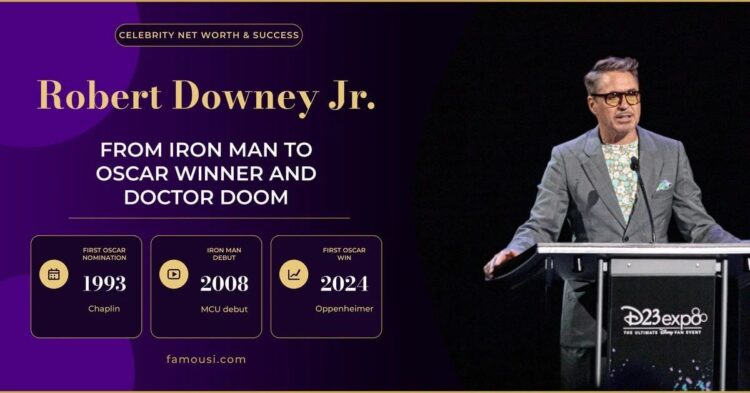
Robert Downey Jr.’s comeback is one of Hollywood’s most remarkable career transformations. Long before he became Iron Man, he had already earned an Academy Award nomination for playing Charlie Chaplin. His early promise was followed by highly publicized personal difficulties and professional setbacks. Then came a gradual return to serious acting work, a defining breakthrough with Iron Man in 2008, and an Oscar-winning performance in Oppenheimer.
His story is often reduced to a simple formula: a troubled actor gets a second chance, plays a superhero, and becomes a global star. But the real timeline is more complicated—and more interesting.
Downey’s success did not begin with Marvel, and it did not end when Tony Stark’s story concluded. His career has moved through dramatic acting, blockbuster filmmaking, production, television and renewed critical recognition. His confirmed return to Marvel as Doctor Doom in Avengers: Doomsday adds another chapter to that evolution.
The question is not simply how Robert Downey Jr. became famous again. It is how he rebuilt a career strong enough to keep changing.
Robert Downey Jr.’s Career: The Milestones Behind His Comeback
| Year | Career milestone | Why it matters |
|---|---|---|
| 1992–1993 | Chaplin and his first Oscar nomination | Established his dramatic ability well before Marvel. |
| 2008 | Iron Man launches the Marvel Cinematic Universe | Gave Downey a defining leading role and introduced Tony Stark to a global film audience. |
| 2009 | Oscar nomination for Tropic Thunder | Demonstrated that major critical recognition was possible outside his superhero role. |
| 2019 | Avengers: Endgame and Disney Legends recognition | Marked the culmination of his original Marvel journey and recognized his contribution to Disney’s entertainment legacy. |
| 2024 | First Oscar win for Oppenheimer | Confirmed a major achievement beyond the character that made him a blockbuster star. |
| 2026 | Scheduled appearance as Doctor Doom in Avengers: Doomsday | Opens a new Marvel chapter with a different character, rather than a straightforward return as Iron Man. |
The sequence reveals three distinct phases: early recognition, commercial reinvention and the expansion of his career beyond the character most closely associated with his fame.
Before Iron Man: A Young Actor With Serious Ambitions
Robert Downey Jr. was born in New York City on April 4, 1965, into a family closely connected to filmmaking. His father, Robert Downey Sr., was an independent filmmaker, while his mother, Elsie Ann Downey, was an actress and writer.
Acting and cinema were familiar parts of his upbringing. Yet proximity to filmmaking did not guarantee an enduring career.
During the 1980s, Downey developed his screen presence through a mixture of youth-oriented films and more demanding roles. He became recognizable to younger audiences while gradually demonstrating an ability to move beyond the conventions of teen entertainment.
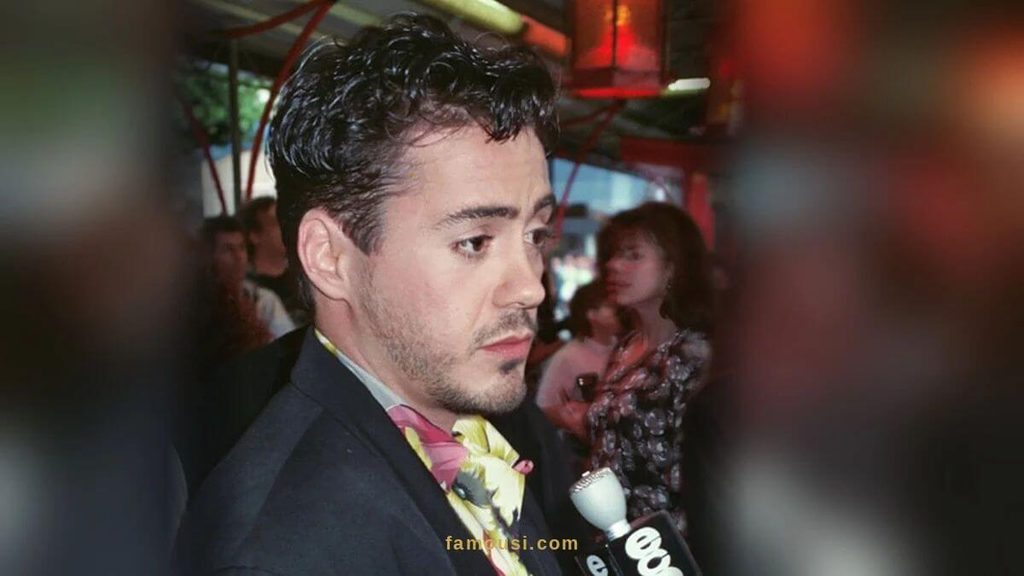
His defining early achievement arrived with Richard Attenborough’s Chaplin in 1992.
Portraying Charlie Chaplin demanded more than a resemblance to a famous performer. Downey had to convey the comic timing, physical expression, emotional complexity and changing public persona of a figure central to film history.
The performance earned him a nomination for Best Actor at the 1993 Academy Awards. The recognition came long before his association with Marvel and established that his dramatic capabilities were not a product of later blockbuster success.
The nomination is documented in the Academy’s official 1993 awards record.
That early achievement matters because it changes the way his later comeback should be understood. Downey was not an unproven actor who suddenly discovered his talent in 2008. He was a performer with substantial ability whose professional journey became increasingly unstable.
The Difficult Years: Talent Was Not Enough
The years following Chaplin did not produce the uninterrupted rise that his Oscar nomination might have suggested.
During the late 1990s and early 2000s, Downey experienced widely documented substance-use problems, legal difficulties and interruptions to his work. These issues affected his professional reliability and complicated his relationships with the entertainment industry.
His career was not entirely inactive during this period. He continued to demonstrate his acting ability, including through the television series Ally McBeal, for which he received significant awards recognition.
Nevertheless, occasional successful performances could not immediately resolve the larger problem of rebuilding professional confidence.
That distinction is important. A comeback involves more than the public recognizing someone’s talent. In an industry built around schedules, production budgets, insurers and long-term commitments, professional consistency matters.
By the mid-2000s, Downey was rebuilding his career through a series of film appearances rather than one instant transformation.
Projects including Kiss Kiss Bang Bang and Good Night, and Good Luck helped reintroduce him to audiences in substantial acting roles. They also demonstrated that his career could continue without depending solely on the fame attached to his earlier work.
A contemporaneous TIME profile published in April 2008 described the contrast between Downey’s earlier professional troubles and the possibility of a new career phase.
The timing is revealing. The story of his recovery and professional return was already developing before audiences saw him become Iron Man.
Marvel would dramatically accelerate his comeback, but it did not create that comeback from nothing.
Why Iron Man Became the Turning Point
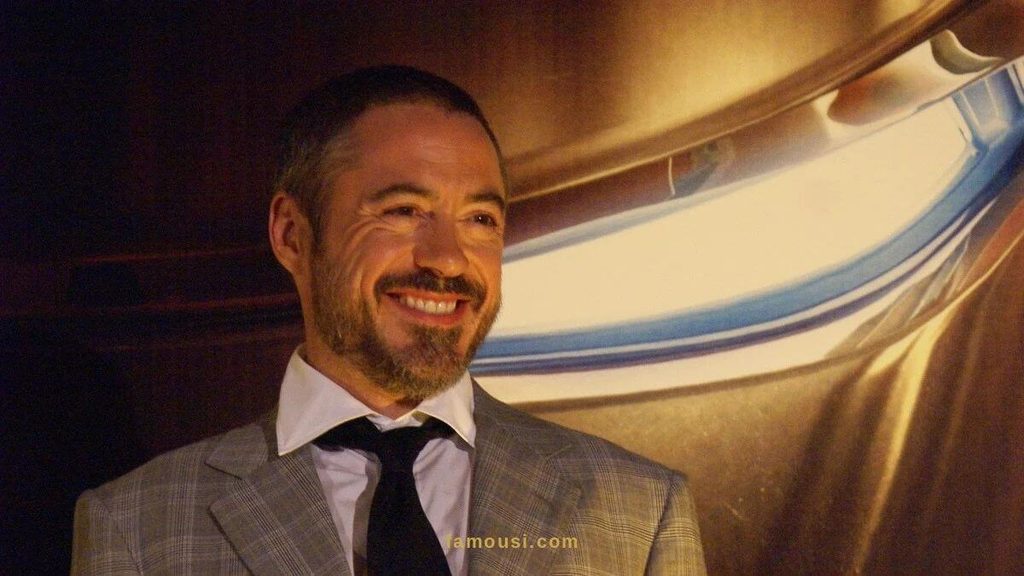
When Iron Man arrived in theaters in 2008, it changed more than Robert Downey Jr.’s career.
The film introduced Tony Stark, an industrialist and inventor whose intelligence, confidence and personal imperfections made him a different kind of superhero lead. Its success also established the starting point of the Marvel Cinematic Universe.
Downey was particularly well suited to a character who needed to be charismatic without appearing perfect.
His performance gave Tony Stark an unusual combination of humor, arrogance, vulnerability and emotional credibility. Audiences could enjoy Stark’s confidence while recognizing that the character’s flaws were essential to the story.
This is an interpretation of what made the performance effective, rather than a claim that any single quality caused the film’s commercial success.
The casting itself was a significant decision.
Director Jon Favreau later recalled that Downey’s screen test made the choice convincing. Disney’s official Robert Downey Jr. biography records Favreau’s account of the audition and the actor’s importance to the film.
What followed created an extraordinary alignment between performer, character and franchise.
As Tony Stark became central to Marvel’s interconnected films, Downey gained the kind of sustained global visibility that relatively few actors experience.
But there is a distinction between appearing in a successful franchise and becoming essential to its identity.
Downey’s performance helped define the personality of Marvel’s early cinematic universe. The rapid dialogue, wit and recognizable imperfections of Tony Stark became closely associated with how audiences understood that expanding fictional world.
For Downey, the professional effect was equally significant: he moved from rebuilding his place in Hollywood to anchoring a major international film franchise.
The Comeback Was Bigger Than One Superhero
One reason the Robert Downey Jr. comeback story has lasted is that his renewed success did not depend exclusively on appearing in an armored suit.
In 2008, he also appeared in the comedy Tropic Thunder. His performance earned him an Academy Award nomination for Best Supporting Actor at the 2009 ceremony.
That nomination is important for a different reason from the success of Iron Man.
It showed that the industry’s recognition of his acting continued across different kinds of films.
In 2009, Downey took on another famous fictional character in Sherlock Holmes, directed by Guy Ritchie. Rather than reproducing the controlled intellectual image often associated with the detective, he brought physical energy, eccentricity and humor to the role.
The film gave him another recognizable leading part outside Marvel and was followed by Sherlock Holmes: A Game of Shadows in 2011.
These performances helped establish two parallel dimensions of his renewed career.
One was the enormous global reach of the Marvel films. The other was his continuing ability to bring a distinct acting personality to different stories.
The distinction matters because a successful comeback is not necessarily measured by the number of franchises an actor joins. It can also be measured by the degree of choice and creative range that renewed professional standing makes possible.
From Iron Man to Avengers: Endgame
Over the following decade, Tony Stark became one of the central characters of the Marvel Cinematic Universe.
Downey returned in Iron Man 2, The Avengers, Iron Man 3 and a series of major crossover films. His character helped connect individual superhero stories into the larger narrative that ultimately reached Avengers: Endgame in 2019.
By then, Iron Man was no longer simply the role that had revived Downey’s career.
Tony Stark had become one of the franchise’s most recognizable characters, and Downey’s public identity was deeply associated with the MCU.
In the same year that Endgame concluded Tony Stark’s original screen journey, Downey was inducted as a Disney Legend.
The honor carried particular significance because it recognized his contribution to a much larger entertainment institution. Downey and director Jon Favreau were honored in the same Disney Legends class, connecting the achievement back to the filmmaking partnership that helped launch Iron Man.
Yet such a long association with one character presents another professional challenge.
After a performer has become inseparable from a globally successful role, how can audiences be persuaded to see something different?
For Downey, that question became increasingly important after 2019.
Oppenheimer: The Oscar Win That Changed the Conversation
Christopher Nolan’s Oppenheimer, released in 2023, provided one of the clearest answers.
Downey portrayed Lewis Strauss, a central figure in the film’s political and institutional conflicts.
The performance required a different kind of presence from the one audiences associated with Tony Stark.
Instead of relying on the fast-moving confidence of an action-film lead, Downey played a character whose authority, insecurity, calculation and resentment emerged through dialogue, expression and increasingly tense interactions.
The role also placed him within an ensemble where he was not expected to dominate the story through star power.
This made the performance particularly revealing. It invited audiences and critics to evaluate Downey as a dramatic actor without relying on the familiar personality of Iron Man.
On March 10, 2024, he won the Academy Award for Best Supporting Actor for Oppenheimer.
It was his first Oscar victory, following his earlier nominations for Chaplin and Tropic Thunder. The result is confirmed in the Academy’s official 2024 winners list.
The significance of that achievement goes beyond completing an awards narrative.
For more than a decade, Downey’s name had been closely connected to the financial and cultural scale of Marvel. His Oscar victory gave his post-Marvel career another defining point of recognition, this time centered on an individual dramatic performance.
The award did not prove that he had only recently become a serious actor. His Chaplin nomination had established his abilities decades earlier.
Instead, it demonstrated that those abilities remained relevant after a long period of extraordinary franchise visibility.
Team Downey and the Expansion Beyond Acting
Robert Downey Jr.’s later career also includes a less visible but significant dimension: producing film and television projects.
He and producer Susan Downey established Team Downey, creating a production business that could participate in developing and producing stories rather than relying solely on Robert’s acting assignments.
This marked a different kind of professional expansion.
An actor’s career generally depends on being offered and choosing roles. A production company can provide additional opportunities to participate in a project’s creative and commercial development, although the extent of that involvement varies by production.
Team Downey’s credits include television and documentary projects such as Perry Mason, Sweet Tooth and Sr., the documentary exploring the life and career of Robert Downey Sr.
The company was also involved with HBO’s The Sympathizer, in which Downey played multiple supporting characters.
His performance earned a nomination for Outstanding Supporting Actor in a Limited or Anthology Series or Movie at the 2024 Emmy Awards, as documented by the Television Academy’s official records.
The project illustrates how Downey continued to seek work outside the conventional blockbuster-leading-man model.
It would be misleading to treat every Team Downey production as his personal artistic creation. Productions involve numerous writers, directors, producers, studios and creative teams.
What can be said is that his career expanded into a documented producing role alongside his acting work.
That diversification is part of the broader success story.
Doctor Doom: A New Marvel Chapter, Not a Return as Iron Man
In July 2024, Marvel made an announcement that immediately changed expectations surrounding Downey’s future in the franchise.
He would return to the Marvel Cinematic Universe, but not as Tony Stark.
Instead, he was announced as Victor von Doom, commonly known as Doctor Doom, for Avengers: Doomsday.
The distinction is essential.
Downey’s casting connects the new film to an actor closely associated with Marvel’s earlier success, but the announced character is different. Doctor Doom is not simply another name for Iron Man.
Marvel’s announcement also confirmed that Anthony and Joe Russo would return to direct the project.
As of October 2026, Disney identifies December 18, 2026, as the film’s scheduled United States theatrical release date. Its more recent promotional coverage explicitly distinguishes Downey’s Doctor Doom role from his former role as Tony Stark.
That confirmation matters because online speculation can blur the line between casting facts and unverified theories about a film’s plot.
The established fact is that Downey is playing Doctor Doom. The character’s complete narrative, motivations and relationship to the film’s other characters should not be presented as fully known before the movie’s release.
For Downey’s career, however, the larger professional significance is already visible.
His original Marvel breakthrough came from being trusted with an important character at a time when his career was still being rebuilt.
His next Marvel chapter arrives after he has become an Oscar-winning actor with an established production career and a long record of international commercial success.
Those are very different professional circumstances.
The return is therefore more interesting than a simple repetition of the past. It is another test of how far a performer can move beyond the character that once defined him.
What Robert Downey Jr.’s Success Story Actually Reveals
It is tempting to interpret Downey’s life as a universal lesson about perseverance. Yet that would flatten a complicated career into an overly convenient message.
His journey involved talent, personal change, professional opportunities, strong collaborators and major decisions by studios and filmmakers.
Not every actor who experiences setbacks will receive comparable opportunities. And no single role, award or business decision can fully explain why one career develops differently from another.
What makes Downey’s story particularly noteworthy is the sequence of different forms of achievement.
Chaplin demonstrated early dramatic credibility. The years that followed exposed the fragility of professional success. Iron Man provided renewed visibility and a defining blockbuster role. Oppenheimer demonstrated that major critical recognition remained possible beyond Marvel. Team Downey added an established production dimension, while Avengers: Doomsday represents another significant acting challenge.
These achievements are related, but they are not interchangeable.
Commercial fame, artistic recognition and creative independence measure different aspects of a career. Downey’s most unusual accomplishment may be that he has experienced substantial success across all three.
Frequently Asked Questions
1. How did Robert Downey Jr. make his comeback?
Robert Downey Jr. rebuilt his career gradually after personal and professional difficulties disrupted his work during the late 1990s and early 2000s. Roles in films including Kiss Kiss Bang Bang helped establish a renewed professional presence. His casting as Tony Stark in Iron Man then produced a major breakthrough when the film launched the Marvel Cinematic Universe in 2008. The comeback continued through other film roles, major franchises and later awards recognition.
2. Which movie made Robert Downey Jr. famous?
Robert Downey Jr. received major critical recognition for playing Charlie Chaplin in the 1992 film Chaplin, which earned him a Best Actor nomination at the 1993 Oscars. However, Iron Man in 2008 transformed his international commercial visibility by introducing him as Tony Stark, one of the defining characters of the Marvel Cinematic Universe. The two films represent different stages of his fame.
3. When did Robert Downey Jr. win his first Oscar?
Robert Downey Jr. won his first Academy Award on March 10, 2024, receiving Best Supporting Actor for his performance as Lewis Strauss in Christopher Nolan’s Oppenheimer. He had previously been nominated for Chaplin at the 1993 Oscars and Tropic Thunder at the 2009 ceremony.
4. Is Robert Downey Jr. returning as Iron Man or Doctor Doom?
Robert Downey Jr. is returning to Marvel as Victor von Doom, also known as Doctor Doom, in Avengers: Doomsday. Disney and Marvel have confirmed that this is a different role from Tony Stark/Iron Man. His casting does not establish that Tony Stark has returned or confirm speculative connections between the two characters.
5. What is Robert Downey Jr.’s next Marvel movie?
Robert Downey Jr.’s next announced Marvel theatrical appearance is Avengers: Doomsday, in which he plays Doctor Doom. As of October 2026, Disney schedules the film for release in U.S. theaters on December 18, 2026. The movie is directed by Anthony and Joe Russo, and its release information remains subject to official updates.
A Career That Refused to Stay in One Chapter
Robert Downey Jr.’s comeback is not most convincingly explained by a single lucky casting decision or one triumphant awards ceremony.
The defining pattern is his ability to establish a new professional identity without entirely losing the value of what came before. The dramatic promise recognized in Chaplin eventually coexisted with the global appeal of Tony Stark. The actor identified with Marvel later earned an Oscar for a very different performance.
Doctor Doom now presents a new question: can Downey create another memorable character inside the same cinematic universe that made him a worldwide blockbuster star?
The answer will depend on the film itself. His career, however, has already demonstrated something more enduring: a defining role can change an actor’s future without having to determine the rest of it.
Readers interested in other documented career journeys can explore Famousi’s Celebrity Net Worth & Success archive.