In This Article
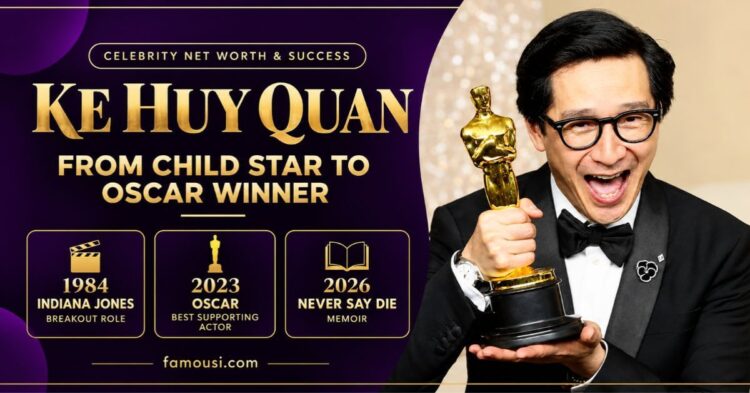
Ke Huy Quan’s comeback story is one of Hollywood’s most extraordinary career reversals. Decades after becoming a beloved child star in Indiana Jones and the Temple of Doom and The Goonies, he returned to the spotlight with Everything Everywhere All at Once, winning the Academy Award for Best Supporting Actor in 2023.
But his Oscar victory tells only part of the story.
Behind that celebrated moment were years of limited acting opportunities, a second career behind the camera, and the difficult decision to pursue a dream he had almost abandoned. His September 2026 memoir, Never Say Die, adds a deeply personal perspective to a journey that began long before Hollywood discovered him.
Ke Huy Quan’s Career: The Defining Turning Points
| Year or Period | Career Milestone | Why It Matters |
|---|---|---|
| Childhood | Fled Vietnam with his family and eventually settled in the United States | His journey began with displacement, uncertainty, and a new life in America. |
| 1984 | Played Short Round in Indiana Jones and the Temple of Doom | Became internationally recognizable as a child actor. |
| 1985 | Played Data in The Goonies | Established another enduring role in popular cinema. |
| 1990s–2000s | Studied filmmaking and worked behind the camera | Built professional skills while acting opportunities remained limited. |
| 2018 | Found renewed inspiration in Crazy Rich Asians | Began reconsidering his future as an actor. |
| 2022 | Returned in Everything Everywhere All at Once | Delivered the performance that transformed his career. |
| 2023 | Won the Academy Award for Best Supporting Actor | Achieved a major milestone decades after his childhood success. |
| 2026 | Published Never Say Die: A Memoir | Shared his experiences of displacement, Hollywood, disappointment, and renewed success. |
From a Refugee Childhood to an Unexpected Hollywood Break
Ke Huy Quan’s early life was shaped by circumstances far removed from the film industry.
Born in Vietnam, he was seven when his family fled the country. His father took him and several siblings to Hong Kong, where they spent time in a refugee camp, while his mother and other family members followed a separate route.
The family eventually reunited in the United States and settled in Los Angeles.
Adapting to a new country brought its own difficulties, including language barriers and experiences of exclusion. Quan later reflected on these challenges during his Academy Awards acceptance speech, connecting his family’s refugee journey to the extraordinary experience of standing on Hollywood’s biggest stage.
His entry into acting was almost accidental.
While attending an English tutoring program, Quan accompanied his brother to an open casting call. He had not planned to audition himself. Nevertheless, the encounter led to an opportunity that changed his life: the role of Short Round opposite Harrison Ford.
As documented in Carnegie Corporation’s profile of Ke Huy Quan, director Steven Spielberg selected him for the 1984 adventure film.
For a child whose family had recently experienced displacement, international recognition arrived with astonishing speed.
Indiana Jones and The Goonies: Two Roles That Defined a Generation
In Indiana Jones and the Temple of Doom, Quan played Short Round, the resourceful young companion to Indiana Jones.
His energy, comic timing, and chemistry with Harrison Ford made the character memorable. The film introduced him to audiences around the world and transformed his everyday life almost overnight.
The following year, Quan appeared as Data in Richard Donner’s The Goonies.
Data, an inventive young adventurer with an assortment of homemade gadgets, became another character closely associated with Quan’s early career.
The two films established him as a recognizable child actor, but they also created an unusual problem: the roles that made him famous were difficult to build into a sustainable adult career.
As he grew older, Hollywood offered him fewer opportunities.
Why Did Ke Huy Quan Disappear From Hollywood?
Quan’s reduced visibility was not simply a matter of losing interest in acting.
As he explained in later interviews, he struggled to find substantial roles as an Asian actor entering adulthood. The industry that had embraced him as a child did not provide a comparable path forward.
This distinction matters.
His early success demonstrated that he could connect with audiences. What became uncertain was whether Hollywood had enough opportunities for him to continue developing as an actor.
Repeated disappointment gradually affected his confidence. Instead of moving naturally from child-star roles into adult performances, he spent years wondering whether his best professional achievements were already behind him.
Eventually, Quan stepped away from pursuing acting as his primary career.
He did not, however, abandon filmmaking.
That decision shaped the next stage of his professional life and would ultimately become part of the experience he brought back to the screen.
The Years Behind the Camera That Changed His Perspective
Rather than leave the film industry entirely, Quan decided to study how movies were made.
He attended the University of Southern California’s School of Cinematic Arts, where he developed a broader understanding of film production and discovered another way to participate in the industry.
His work eventually included action filmmaking, stunt coordination, and behind-the-camera responsibilities.
In a September 2026 conversation with organizational psychologist Adam Grant for TED’s ReThinking podcast, Quan described how his connection with action director Corey Yuen helped him begin working behind the camera on X-Men.
He also explained how the experience changed his perspective. Instead of thinking only about performing a scene, he learned to consider how action sequences were designed, photographed, and edited.
Those years were not a direct route to an Oscar. They were a different professional chapter, one that broadened his abilities while his desire to act remained unresolved.
In retrospect, the distinction is important: Quan’s comeback did not erase the work he had done outside the spotlight. That work became part of the experience he carried into his later performances.
How Crazy Rich Asians Inspired Ke Huy Quan to Return
A crucial turning point came in 2018.
When Quan watched Crazy Rich Asians, he saw a major Hollywood production built around a predominantly Asian cast.
For someone who had struggled to find roles as an Asian actor, the film represented a meaningful change in what seemed possible.
Its success encouraged him to reconsider whether the industry might finally offer opportunities that had previously been unavailable.
The decision was not immediate or uncomplicated.
Returning to acting meant confronting the prospect of rejection after years of disappointment. It also meant rebuilding a career in an industry that had changed significantly since his childhood.
Quan has credited his wife, Echo, with believing in his potential even during periods when he doubted himself.
He eventually decided to try acting again.
In his TED conversation, he recalled receiving the opportunity connected to Everything Everywhere All at Once shortly after making that decision.
The timing was remarkable, but the result was not inevitable. His successful return depended on the availability of a suitable role, the filmmakers’ creative choices, and a performance capable of bringing that role to life.
Everything Everywhere All at Once: The Performance That Reintroduced Him
Released in 2022, Everything Everywhere All at Once provided the breakthrough Quan had been seeking.
Written and directed by Daniel Kwan and Daniel Scheinert, the film follows Evelyn Wang, played by Michelle Yeoh, as an ordinary family’s struggles become entangled with an extraordinary multiverse adventure.
Quan plays Evelyn’s husband, Waymond Wang.
Unlike his childhood adventure roles, Waymond required him to explore contrasting sides of one character: vulnerability, humor, physical action, and emotional restraint.
The film’s shifting realities gave Quan opportunities to combine dramatic performance with the action experience he had developed behind the camera.
According to A24’s official film information, the movie brought together a cast including Michelle Yeoh, Stephanie Hsu, Ke Huy Quan, James Hong, and Jamie Lee Curtis.
For Quan, the role was more than a return to a familiar profession.
It demonstrated that audiences could respond to him as an adult actor capable of carrying complex emotional material rather than simply recognizing him from his childhood films.
The 2023 Oscar: A Career Milestone Decades in the Making
On March 12, 2023, Quan won the Academy Award for Best Supporting Actor for his performance as Waymond Wang.
The result is confirmed by the Academy’s official 2023 awards record.
His emotional acceptance speech recalled his refugee experience, acknowledged his mother, and celebrated a dream that had survived years of uncertainty.
The victory resonated because it connected several chapters of his life: a childhood shaped by displacement, sudden fame, professional disappointment, a long period behind the camera, and a return few could have predicted.
Yet the award did not prove that every obstacle in Hollywood had disappeared.
Quan’s personal achievement was significant precisely because it followed years in which the opportunities he wanted were difficult to find.
What Happened to Ke Huy Quan After His Oscar Win?
The Academy Award marked a new phase rather than the conclusion of Quan’s career.
Following his success in Everything Everywhere All at Once, he expanded into roles that allowed him to explore different genres and reach new audiences.
In the 2025 action-comedy Love Hurts, Quan played Marvin, a seemingly ordinary real estate agent whose dangerous past returns to disrupt his life. The film gave him a prominent action-oriented leading role, drawing on abilities developed during his years working on stunt and action productions.
He also joined Disney’s animated film Zootopia 2, released in November 2025, voicing Gary De’Snake, a mysterious reptile central to the story.
Disney’s official Zootopia 2 film page confirms his voice role and the film’s release.
These projects demonstrate a broader professional shift.
Instead of depending solely on the nostalgia associated with Short Round and Data, Quan was participating in contemporary productions as an Oscar-winning adult performer.
His career was no longer defined exclusively by the work he had done as a child.
Never Say Die: Ke Huy Quan Tells His Story in His Own Words
On September 15, 2026, Quan published Never Say Die: A Memoir through Grand Central Publishing.
The book revisits his journey from Vietnam to the United States, his experience as a child actor, the disappointment of losing professional momentum, and his eventual return to Hollywood.
The timing makes the memoir especially relevant.
Earlier coverage often presented his comeback through the dramatic contrast between childhood fame and Oscar-night recognition. His memoir offers a more personal examination of the years between those milestones.
The book’s official description emphasizes not only success but also the emotional consequences of fading from the spotlight and finding a renewed sense of purpose.
Readers can explore the publisher’s official Never Say Die memoir description for details about the release and its subject matter.
In a September 2026 interview with Here & Now, Quan also discussed his memoir and reflected on the experiences that shaped his career.
His decision to tell the story himself adds depth to a public narrative that might otherwise be reduced to a simple message about perseverance.
A Hollywood comeback can make an inspiring headline. Understanding the years before it reveals a more complicated story about opportunity, identity, professional reinvention, and timing.
Frequently Asked Questions About Ke Huy Quan
1. Why did Ke Huy Quan stop acting?
Ke Huy Quan stepped away from pursuing acting as his main profession because substantial roles became increasingly difficult to find as he grew older. He has described the lack of opportunities for Asian actors in Hollywood as a major factor. Instead of leaving filmmaking altogether, he studied cinema and built a career working behind the camera. His departure was therefore a change in professional direction, not a complete disappearance from the film industry.
2. How did Ke Huy Quan become famous?
Ke Huy Quan became famous after playing Short Round in Steven Spielberg’s Indiana Jones and the Temple of Doom in 1984. He secured the role following an open casting call he originally attended with his brother. In 1985, he played Data in The Goonies, establishing another memorable character and strengthening his reputation as a child actor.
3. What brought Ke Huy Quan back to acting?
Watching Crazy Rich Asians in 2018 helped inspire Ke Huy Quan to reconsider acting. The film’s predominantly Asian cast and commercial success suggested that Hollywood might be changing. Encouraged by his wife and his continuing passion for performance, he decided to audition again. He subsequently secured the role of Waymond Wang in Everything Everywhere All at Once, released in 2022.
4. What Oscar did Ke Huy Quan win?
Ke Huy Quan won the Academy Award for Best Supporting Actor on March 12, 2023, for playing Waymond Wang in Everything Everywhere All at Once. The award recognized his performance in the 2022 film and became one of the defining milestones of his professional comeback.
5. What is Ke Huy Quan’s Never Say Die memoir about?
Never Say Die: A Memoir tells the story of Ke Huy Quan’s life, beginning with his family’s refugee experience and continuing through his childhood Hollywood success, years of professional difficulty, and eventual return to acting. Published by Grand Central Publishing on September 15, 2026, the book offers his personal perspective on resilience, filmmaking, identity, and rediscovering an ambition he had once set aside.
A Comeback That Changed the Meaning of His Early Success
Ke Huy Quan’s story is powerful because his Hollywood career did not follow a predictable path.
The child actor who once seemed destined for continued stardom spent much of his adult professional life pursuing filmmaking in a different capacity. When the opportunity to act returned, he brought those experiences with him.
His Oscar did not make the difficult years disappear. It gave them a different place in the story.
By 2026, with a memoir offering his own account of that journey, Quan’s career stood as a reminder that professional success is not always continuous—and that a second chapter can be as meaningful as the first.
For more stories about careers, achievements, and professional reinvention, explore Famousi’s Celebrity Net Worth & Success collection.