In This Article
Coach’s comeback is more convincing when it is read as a long brand transformation rather than a sudden viral moment. The New York house did not simply rediscover an old logo or land on one successful handbag. It found ways to make its leather heritage, archival design language and American identity useful to a new generation without making the brand unrecognizable.
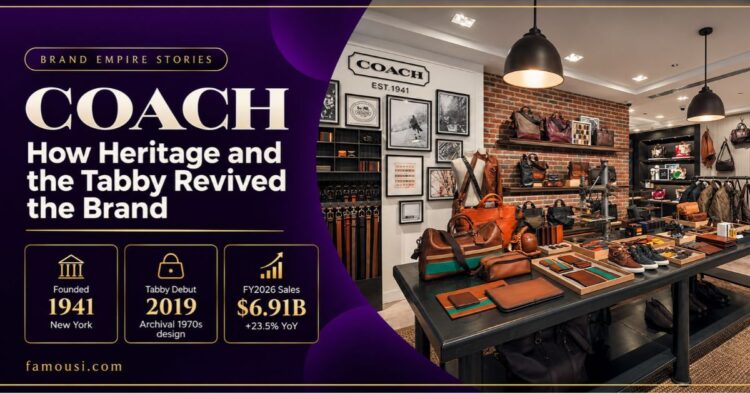
That pattern stretches from Coach’s 1941 beginnings through Bonnie Cashin’s design influence, Stuart Vevers’s creative reset and the rise of the Tabby bag. The commercial evidence is now substantial: Coach reported $6.91 billion in net sales for fiscal 2026, up 23.5% from the prior year, while its current brand activity openly speaks to younger consumers and celebrates the house’s 85th anniversary.
The useful question is therefore not simply, “Is Coach popular again?” It is how a heritage leather company learned to make its past feel contemporary.
The Coach Comeback in Six Milestones
| Period | What changed | Why it matters to the comeback | Evidence qualification |
|---|---|---|---|
| 1941 | Coach was founded in New York by six artisans. | Leather craftsmanship became the original foundation of the brand rather than a later marketing story. | Coach’s official history |
| 1962 | Bonnie Cashin became Coach’s first lead designer. | Color, proportion, practicality and distinctive hardware expanded what a Coach bag could look like. | Coach’s official history |
| 2013 | Stuart Vevers was appointed to lead Coach’s creative direction during an acknowledged brand transformation. | The archive became material for a new visual language rather than something to preserve unchanged. | Contemporary Coach/Tapestry announcement |
| 2019 | The Tabby debuted, drawing on an archival 1970s Coach design. | One product made the heritage-to-modern strategy unusually visible to consumers. | Coach Editorial |
| FY2026 | Coach net sales reached $6.9147 billion, up 23.5% year over year. | The revival is visible in audited commercial performance, not only fashion commentary. | Tapestry SEC filing; fiscal-year scope |
| 2026 | Coach marked its 85th anniversary while promoting projects co-created with Gen Z. | Heritage and younger-customer engagement now operate alongside each other rather than as opposing strategies. | Current Coach site; time-sensitive |
Coach Started With Leather Before It Started With Lifestyle
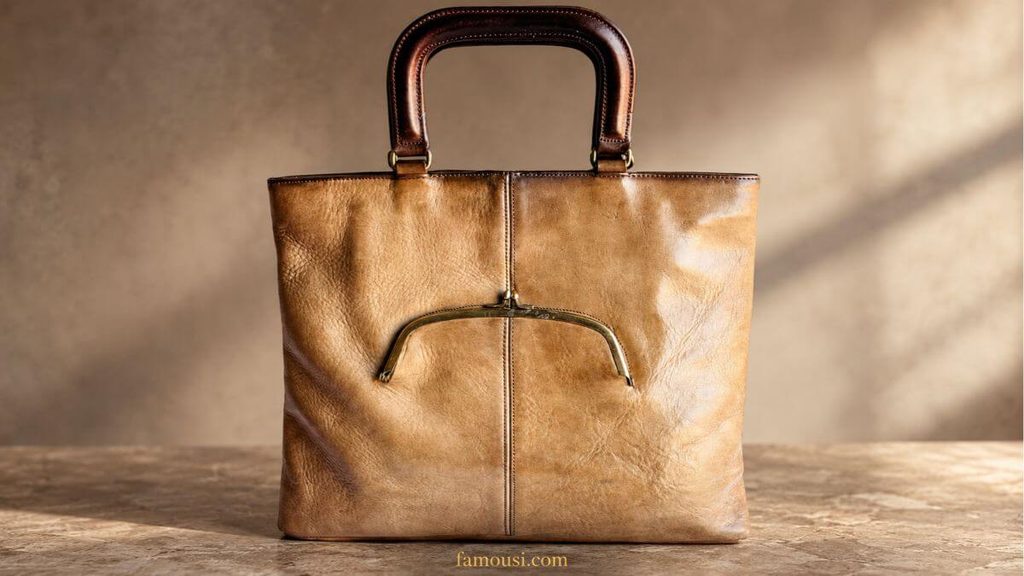
According to Coach’s official history, the company began in New York in 1941 with six artisans and later grew under Lillian and Miles Cahn. That origin matters because leathercraft was not added to the brand after it became successful. It was the operating idea from the beginning.
Coach describes itself as the “Original American House of Leather,” but the historical value of that phrase is more useful than the slogan itself. The company built recognition around materials, practical construction and objects designed for repeated use. Those characteristics gave later designers something concrete to reinterpret.
That pattern is familiar in enduring brands. Famousi’s Lacoste history shows a different industry reaching a similar advantage: recognizable codes can give a company room to evolve without requiring every new generation to relearn what the brand represents.
For Coach, the early code was leather.
Bonnie Cashin Expanded the Meaning of a Coach Bag
A major shift came in 1962, when Miles Cahn hired Bonnie Cashin as Coach’s first lead designer.
Coach credits Cashin with bringing a more adventurous approach to color, proportion and functionality. Her role is important because the company’s history was no longer only about making durable leather goods. Design itself became a stronger form of brand expression.
This distinction helps explain why Coach has repeatedly been able to return to its archive. An archive becomes valuable when it contains more than old products. It needs recognizable ideas—shapes, hardware, materials, proportions or attitudes—that can be interpreted again.
Coach’s later comeback depends heavily on that principle.
The heritage matters, but copying the past exactly would not have been enough. The more useful strategy was to identify parts of the past that could still produce something contemporary.
Stuart Vevers Arrived With an Explicit Transformation Mandate
The modern turning point became clearer in 2013.
When Coach appointed Stuart Vevers as Executive Creative Director, the company described the appointment as an important milestone in a brand transformation already underway. The announcement gave him responsibility across design, brand imagery and store environments, not simply a seasonal handbag collection. The 2013 appointment announcement also emphasized his ability to work from Coach’s history while developing the brand’s next chapter.
That wider mandate matters.
A comeback rarely works if product, stores and imagery communicate different identities. Coach’s transformation involved making those pieces feel like parts of the same brand again.
Vevers did not erase the leather-house story. Coach’s current history says he has been reimagining that heritage since 2013 and that his collections have introduced the brand to a new generation.
That wording comes from Coach itself, so it should not be mistaken for independent proof that one designer caused every later sales increase. What it does establish is continuity of creative direction: heritage became an active design source during the same long period in which Coach rebuilt its contemporary relevance.
The Tabby Made the Archive Feel Current
The Tabby is perhaps the clearest product expression of that strategy.
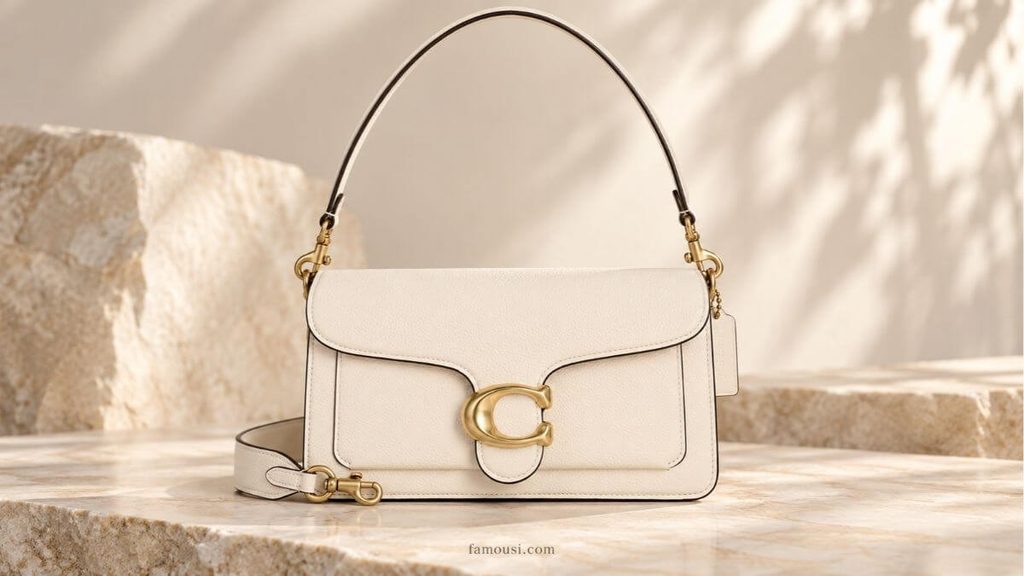
Coach says the bag debuted in fall 2019 and was inspired by an archival design from the 1970s. Coach’s Tabby history describes the modern version as a reinterpretation rather than a reproduction.
That difference is central to the comeback story.
The Tabby carries obvious Coach codes, including the “C” hardware and a structured leather silhouette, but it is presented as a contemporary family of products with different sizes, materials and styling possibilities. The archive gives the design recognition; the new versions give customers reasons to treat it as current fashion.
The Tabby should not be credited as the sole cause of Coach’s growth. Public evidence does not establish that kind of clean causal relationship. It is more accurate to call it one of the strongest visible examples of the broader strategy.
Independent reporting supports its importance. Reuters has repeatedly identified demand for Tabby handbags and other Coach leather goods as part of the company’s recent momentum, particularly among younger shoppers.
The significance is therefore larger than one bag.
Coach found a product that could simultaneously look archival and contemporary—a particularly useful position for a brand trying to recover heritage credibility without becoming nostalgic.
Coach Learned to Treat Younger Consumers as Participants, Not Just Targets
The second side of the comeback is audience strategy.
Coach’s current website is unusually explicit about this. In 2026, the company is celebrating its 85th anniversary while promoting &Coach, which it describes as being “co-created with Gen Z.” Coach’s current brand activity places that younger-consumer language directly alongside an anniversary built around heritage.
That combination is revealing.
A traditional heritage strategy might ask younger consumers to appreciate an old brand on the brand’s terms. Coach has increasingly done something different: it has made personalization, self-expression, community and participation part of the way the brand communicates.
This does not mean every young consumer wants Coach, nor does it allow a precise share of Coach sales to be attributed to Gen Z from the public evidence available. But independent industry reporting confirms that Coach has gained meaningful traction with younger shoppers while many luxury companies have found that audience difficult to hold. Reuters has described Coach as one of the more accessible established brands gaining favor with Gen Z.
Famousi’s Miu Miu growth story illustrates a useful contrast. Miu Miu’s recent momentum comes from a very different aesthetic and corporate history, but both stories show that younger attention is more durable when a brand already has a distinct identity to reinterpret.
The common lesson is not “chase Gen Z.”
It is that a brand needs enough identity to invite participation without losing itself.
The Commercial Results Show This Is More Than a Fashion Narrative
The strongest evidence that Coach’s revival has commercial substance comes from Tapestry’s fiscal 2026 filing.
Coach generated $6.9147 billion in net sales for the fiscal year ended June 27, 2026, compared with $5.5985 billion the previous year. That was an increase of 23.5% as reported, or 22.5% in constant currency. Tapestry attributed most of the increase to higher direct-to-consumer sales, particularly across North America, Greater China and Europe. Tapestry’s fiscal 2026 SEC filing
Handbags remained central. The filing reports $4.0163 billion in Coach handbag sales during FY2026, equivalent to 58.1% of Coach segment net sales.
Those numbers do not tell us why every customer made a purchase. They do, however, establish that the comeback narrative is not merely based on social-media attention.
Coach also operated 973 stores in fiscal 2026, up from 931 in fiscal 2025: 336 in North America and 637 internationally.
The numbers should be read as dated business evidence, not permanent facts. But they show the scale at which Coach now has to manage the harder phase of a comeback: maintaining desirability after renewed popularity has already become visible.
The Harder Challenge Is What Comes After the Comeback
Successful revivals create their own risk.
A heritage brand can lose momentum if its newly popular products become too common, if pricing moves faster than perceived value, or if the company starts chasing the audience that originally responded to a clearer identity.
Business of Fashion has described Coach as benefiting from a years-long turnaround while also highlighting the challenge of sustaining momentum and avoiding the ubiquity problem that affected the brand in earlier periods.
That makes the next stage different from the last one.
Coach no longer needs to prove that a comeback is possible. It needs to prove that a stronger brand can remain culturally interesting as it becomes commercially larger.
Its best defense may be the same mechanism that helped create the revival: use recognizable heritage as raw material rather than as a museum exhibit.
Famousi’s Fendi history shows why that distinction matters across long-lived fashion houses. Continuity works when old codes can generate new design decisions, not when the brand simply repeats old products.
Frequently Asked Questions About the Coach Comeback
Why is Coach popular again?
Coach is popular again because several changes have reinforced one another over time: the brand returned attention to its leather heritage, developed a more coherent contemporary identity under Stuart Vevers, created products such as the Tabby that translate archival ideas into current design, and built stronger engagement with younger consumers. Fiscal 2026 sales provide evidence that the renewed attention has translated into commercial growth, although public evidence does not prove that any single product or demographic caused the entire increase.
When did the Coach comeback begin?
There is no single authoritative date for the Coach comeback. A useful turning point is 2013, when Stuart Vevers was appointed during an explicitly described brand transformation. The process continued through product, retail and marketing changes over subsequent years. The Tabby’s debut in 2019 is another important milestone because it made the archive-to-modern design strategy especially visible.
What role did Stuart Vevers play in Coach’s comeback?
Stuart Vevers has led Coach’s creative direction since 2013. His original mandate covered design, imagery and store environments, and Coach says he has spent that period reimagining the house’s heritage for a new generation. It is reasonable to describe him as a central creative figure in the transformation, but it would be too broad to attribute every commercial result or customer trend to one designer.
Why is the Tabby bag important to Coach’s comeback?
The Tabby is important because it connects Coach’s archive directly to a contemporary product. Coach says the bag debuted in fall 2019 and reinterprets an archival 1970s design. Its success demonstrates how the company can reuse recognizable heritage without reproducing an old product unchanged. The Tabby is a major expression of the comeback strategy, not proven to be its sole cause.
How big is Coach now?
For the fiscal year ended June 27, 2026, Coach reported $6.9147 billion in net sales, up 23.5% from the previous fiscal year. Tapestry’s filing also reported 973 Coach stores in fiscal 2026, including 336 in North America and 637 internationally. These are fiscal 2026 figures and should not be treated as undated permanent counts.
Coach’s Comeback Works Because the Past Still Produces New Ideas
Coach’s revival is strongest when it is understood as continuity through reinterpretation.
The 1941 leather workshop created an origin the company could keep returning to. Bonnie Cashin expanded that heritage into a richer design language. Stuart Vevers arrived with an explicit transformation mandate and treated the archive as creative material. The Tabby turned that logic into a visible modern icon. Younger consumers then encountered a heritage company that was asking them to participate in its current identity rather than simply admire its history.
The fiscal 2026 results show how far that system has traveled.
The next test is not whether Coach can become popular again—it already has strong evidence of renewed momentum. The harder question is whether the brand can continue changing without making the codes behind its comeback feel ordinary.