In This Article
How a Roman family house kept renewing its craft, creative leadership, icons and sense of place across a century.
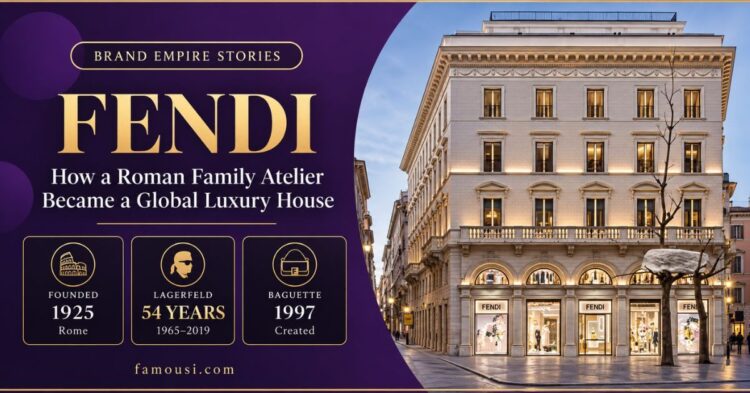
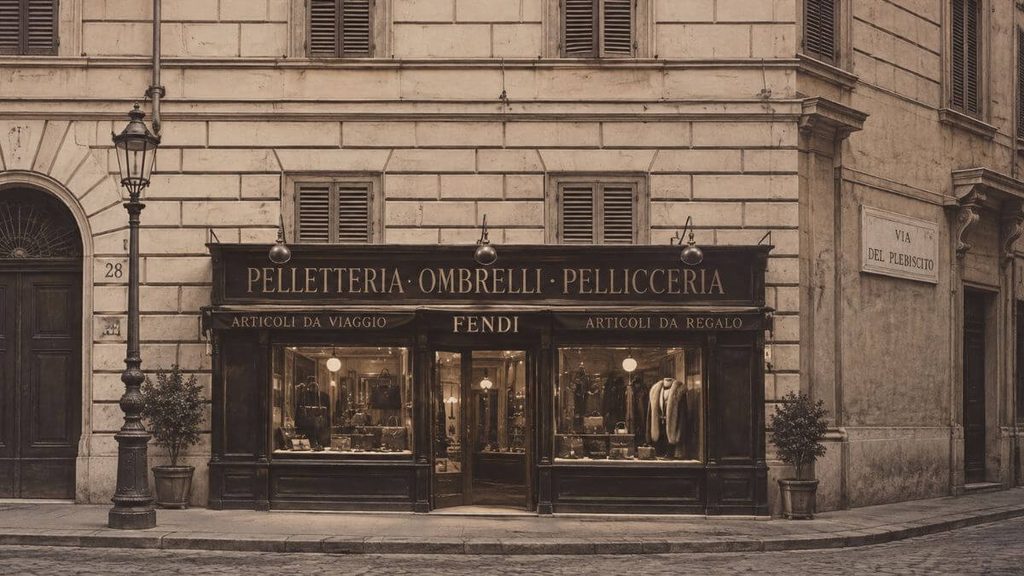
Fendi’s history begins in Rome in 1925, when Adele Casagrande and Edoardo Fendi opened a fur and leather-goods workshop. A century later, the house is still recognizably Roman, but almost every other part of its operating story has changed: leadership passed through generations of the Fendi family, Karl Lagerfeld brought an outsider’s creative disruption, accessories became powerful brand codes, LVMH changed the ownership structure, and a new creative chapter is now led by Maria Grazia Chiuri. Fendi’s official heritage record still anchors that story in the original workshop and the five daughters who followed its founders.
The useful way to read that timeline is not as a sequence of famous names. It is as a pattern of continuity through change. Fendi repeatedly kept a recognizable core – Roman identity, craft and family memory – while allowing new designers, products, owners and settings to reinterpret what that core could look like. That is why the story fits Famousi’s Brand Empire Stories: the important question is not simply how old the brand is, but how its identity remained usable as the business changed around it.
The Turning Points in Fendi’s First Century
These milestones matter because each changed the way Fendi could carry its identity forward – through leadership, an icon, ownership, place or creative direction.
| Year / period | What changed at Fendi | Why it mattered |
| 1925 | Adele Casagrande and Edoardo Fendi establish the house in Rome around fur and leather goods. | Creates the craft and Roman foundation that later generations keep reworking. |
| 1965 | The five Fendi sisters bring in Karl Lagerfeld as the house’s first Artistic Director. | Introduces a long outside creative partnership without erasing the family structure. |
| 1997 | Silvia Venturini Fendi creates the Baguette. | Shows how one accessory can become a reusable symbol of the house. |
| 2000-2001 | LVMH enters Fendi in 2000 and becomes majority shareholder in 2001. | Changes the ownership structure while Fendi’s creative identity continues to draw on family leadership. |
| 2007 | Fendi stages a fashion show on the Great Wall of China. | Turns a collection presentation into a global-scale expression of the brand. |
| 2015-2016 | Fendi moves its offices to Palazzo della Civilta Italiana, then marks its 90th anniversary with a Trevi Fountain show. | Makes Rome itself part of the modern corporate and cultural presentation of the house. |
| 2025 | Fendi celebrates its centenary; Silvia Venturini Fendi becomes Honorary President; Maria Grazia Chiuri is appointed Chief Creative Officer. | Places family continuity and a new creative organization side by side at the century mark. |
| 2026 | Chiuri presents her first Fendi collection, Fall-Winter 2026-2027. | Begins the latest verified creative chapter rather than leaving the centenary as an endpoint. |
A Roman workshop became a family system
Fendi did not start as an abstract luxury label. Its earliest documented identity was practical and place-specific: a Rome workshop for fur and leather goods. The founders supplied the first layer of continuity, but the more consequential structural change came when their five daughters entered the business. Fendi’s own history and current LVMH profile treat the sisters as the bridge between the founding generation and the house’s later creative expansion. LVMH’s current Fendi profile records the same 1925 foundation and the transition to the five-sister era.
That family structure matters because it made continuity collective rather than dependent on one founder. The house could absorb new creative voices without having to pretend it was starting over. In Fendi’s later history, that becomes a recurring pattern: a new person or institution changes the way the brand operates, while the Roman family story remains available as a source of identity.
The five sisters opened the door to creative disruption
The most important example arrived in 1965. The five Fendi sisters hired Karl Lagerfeld as the Maison’s first Artistic Director. The decision is important precisely because he was not a member of the family. Fendi was effectively adding an external creative engine to a house whose authority had been built around family craft and continuity.
Fendi says Lagerfeld created a new logo and the ‘FF’ or ‘Fun Fur’ mantra in his first year. That wording is the company’s own account, but the dates are unusually clear: the collaboration began in 1965, and LVMH records it as a 54-year relationship. The value of that fact is not the record-book quality of the number. It shows how long Fendi allowed an outsider’s creative logic to operate inside a family-rooted house.
This is one of the central tensions in Fendi history. Heritage was not treated as a requirement to make the same object in the same way. The heritage became a platform from which materials, silhouettes and visual codes could be changed. Fendi’s official fur archive credits Lagerfeld with making fur lighter, more colorful and more graphic. The article can accept that as Fendi’s description of its own creative development without turning it into an independent claim about the whole fashion industry.
Silvia Venturini Fendi turned continuity into products people could recognize
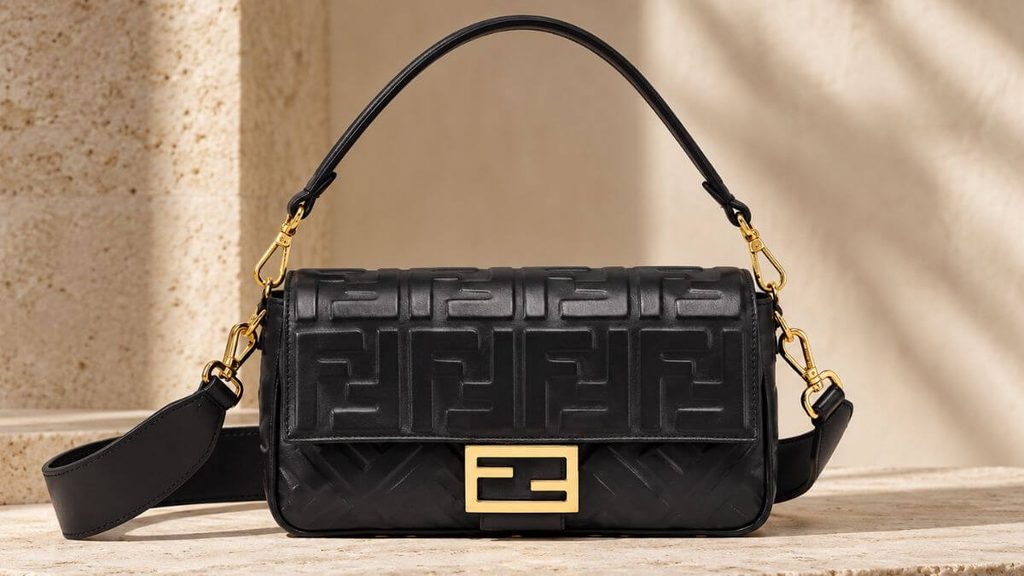
The family thread did not disappear during the Lagerfeld era. Silvia Venturini Fendi joined him in Artistic Direction in 1992 and took responsibility for Accessories in 1994, later adding Menswear. Five years after joining the artistic leadership, she created the Baguette in 1997. Fendi now describes the bag on its own product pages as the first ‘It’ bag; that superlative is best read as Fendi’s own characterization of the Baguette, not as a neutral historical ranking.
The more useful point is what the Baguette demonstrates about brand building. A heritage house does not remain legible only through its founding craft. It also needs forms that compress the brand into something audiences can recognize quickly. The Baguette gave Fendi such a form: an accessory with a name, silhouette and FF hardware that could be reinterpreted without losing its connection to the house.
That mechanism is not unique to Fendi. Famousi’s Prada Re-Nylon analysis examines another luxury house using a recognizable code as design infrastructure rather than freezing it in one historical version. The comparison is useful because it highlights a broader principle without collapsing the two brands into the same story: durable codes are valuable when they can change and still remain recognizable.
Fendi learned to make place part of the brand
Fendi’s identity is not only carried by products. It is repeatedly staged through Rome and through high-visibility cultural settings. In 2007, Fendi presented a fashion show on the Great Wall of China. In 2016, the house marked its 90th anniversary with a show at Rome’s Trevi Fountain. These were not ordinary store openings or advertising claims; they were documented fashion events that linked collections to places with their own symbolic weight.
The Great Wall event pushed Fendi’s presentation beyond Rome, while the Trevi Fountain pulled the story back to the city most closely associated with the house. Together they show a useful dual strategy: global spectacle did not require Fendi to abandon Roman identity. The brand could move outward and then use Rome again as proof of continuity.
The Palazzo made Roman heritage part of Fendi’s daily identity
In 2015, Fendi moved its offices to the Palazzo della Civilta Italiana, the monumental Roman building in EUR. The move is more than a convenient headquarters fact because it placed the contemporary organization inside a highly visible piece of Roman architecture. Fendi’s history page describes the move as a way to honor its heritage while looking forward. Current Fendi company information still lists the Palazzo as the registered address for Fendi Italia Srl and Fendi Srl.
That makes the Palazzo a particularly strong symbol for the modern house: it connects the city, the corporate organization and the idea of transformation without pretending to be Fendi’s original 1925 site. The distinction matters. The power of the location comes from what Fendi chose it to represent in the present, not from rewriting the origin story around a later headquarters.
LVMH changed the ownership structure, not the need for a Fendi identity
Corporate ownership is a material part of Fendi history, but it should not become the whole story. Fendi’s own history and LVMH’s Maison profile record LVMH entering Fendi in 2000 and becoming majority shareholder in 2001. Current Fendi legal information states that Fendi Italia Srl and Fendi Srl are subject to the direction and coordination of LVMH Moet Hennessy Louis Vuitton SE.
Those facts establish the current group relationship without requiring an unsupported ownership percentage. More importantly for the brand story, the LVMH transition did not remove the Fendi family from the creative narrative. Silvia Venturini Fendi continued to hold major creative responsibilities for decades, and in 2025 she moved into the role of Honorary President. The result is not a simple family-versus-group story. It is a layered structure in which corporate control, family memory and creative leadership can be held by different people and institutions.
The centenary became a transition, not an endpoint
Fendi’s 100th anniversary in 2025 could have been treated as a museum-like celebration of the past. Instead, the year became a hinge between creative eras. The centenary show was orchestrated by Silvia Venturini Fendi and explicitly drew on memories of the five sisters. Later that year, Silvia became Honorary President, and on October 14 Fendi appointed Maria Grazia Chiuri as Chief Creative Officer. LVMH’s appointment announcement framed the move as a return: Chiuri had begun her career at Fendi under the five sisters.
That link between return and renewal became visible in 2026. Chiuri’s first Fendi collection was Fall-Winter 2026-2027, presented in March 2026. LVMH’s coverage of the debut describes the show as a new chapter built around collective creativity and the memory of the five sisters. A September 2026 LVMH jury announcement still identifies Chiuri as Fendi’s Chief Creative Officer, so the role remains current at the time of this article.
The significance is not that Fendi returned to an old employee and therefore went backward. It is that the latest creative organization again uses the house’s history as working material. The five sisters are not presented only as archival figures; their collective model is being used to explain a contemporary creative direction.
What Fendi history reveals about a durable luxury brand
Across the century, Fendi’s strongest continuity is not a single designer, owner or product. It is the ability to preserve a recognizable center while changing the system around it. The founders established the Roman craft base. Their daughters turned the family into a second-generation operating structure. Lagerfeld supplied long-term creative disruption. Silvia Venturini Fendi translated continuity into accessories and later broader creative leadership. LVMH changed the ownership framework. Rome remained visible through headquarters and cultural events. Chiuri now leads the latest creative chapter.
That interpretation also has limits. The source set used for this article documents dates, appointments, ownership transitions and named creative milestones, but it does not provide a clean standalone public revenue history for Fendi that would let us measure each creative decision against financial performance. This article therefore does not use LVMH group or business-segment figures as if they were Fendi-only results. The history is strongest where the evidence is strongest: in the documented relationship between people, products, places and institutional change.
Frequently Asked Questions
1. When was Fendi founded and who founded it?
Fendi was founded in Rome in 1925 by Adele Casagrande and Edoardo Fendi. The house’s own heritage material describes the original business as a fur and leather-goods workshop on Via del Plebiscito, followed by the era of their five daughters.
2. Who owns Fendi today?
Fendi sits within the LVMH group. Current Fendi company information says Fendi Italia Srl and Fendi Srl are subject to the direction and coordination of LVMH Moet Hennessy Louis Vuitton SE, while Fendi and LVMH historical materials record LVMH entering the company in 2000 and becoming majority shareholder in 2001. The public sources used for this article do not establish a current ownership percentage, so no exact percentage is asserted here.
3. What did Karl Lagerfeld change at Fendi?
Karl Lagerfeld became Fendi’s first Artistic Director in 1965 and worked with the house for 54 years. Fendi says he created the FF or ‘Fun Fur’ logo and mantra in his first year and used the atelier’s craft to push fur toward lighter, more colorful and more graphic treatments. The broader conclusion is therefore best stated carefully: Lagerfeld gave Fendi a long-running external creative force inside a family-rooted house.
4. Who designed the Fendi Baguette and when was it created?
Silvia Venturini Fendi created the Baguette in 1997. Fendi’s current product descriptions call it the first ‘It’ bag; because that is the brand’s own characterization, it is more precise to attribute the label to Fendi than to present it as an uncontested historical ranking.
5. Who is Fendi’s creative director in 2026?
Maria Grazia Chiuri is Fendi’s Chief Creative Officer in 2026. She was appointed on October 14, 2025 and presented her first Fendi collection, Fall-Winter 2026-2027, in March 2026. LVMH was still identifying her as Fendi’s Chief Creative Officer in September 2026.
Why Fendi’s history still feels unfinished
Fendi’s century is best understood as a chain of controlled reinventions. The house has not stayed recognizable by keeping every element fixed. It has stayed recognizable by deciding which elements can carry change: a family memory, a Roman setting, a craft tradition, an accessory code or a creative relationship.
That is also why the current Chiuri era belongs inside the history rather than after it. Fendi has reached 100 years, but its defining habit is still the same one visible at earlier turning points: use the past as a source of identity, then ask a new generation to do something with it.