In This Article
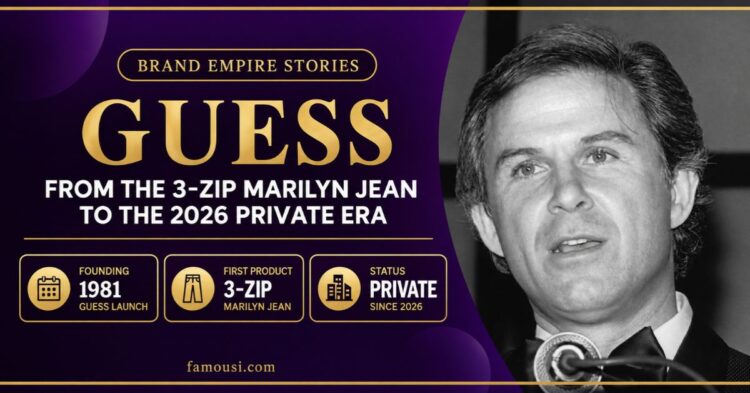
GUESS began in 1981 with a denim idea, but the more useful way to understand its history is as a sequence of reinventions around one recognizable brand image. The Marciano brothers brought apparel experience from France to California, launched GUESS around the three-zip Marilyn jean, built advertising into a central part of the brand itself, expanded through stores, distribution and licensing, and eventually developed a business reaching roughly 100 countries.
Then, on January 23, 2026, the structure changed again. GUESS became private, with Authentic taking 51% of substantially all GUESS intellectual property, the existing rolling shareholders holding 49%, and current GUESS management owning 100% of the operating company. That distinction matters: the 2026 deal was not simply a conventional acquisition in which one buyer took over every part of the business.
| Period | GUESS turning point | What changed | Why it matters |
|---|---|---|---|
| 1972–1978 | The Marciano brothers worked in apparel in France, then opened U.S. retail stores in California | European apparel experience moved into the U.S. market | GUESS did not begin from zero; its founders already had product and retail experience before the brand existed. |
| 1981 | GUESS was founded and the three-zip Marilyn became its first product | Denim became the original vehicle for the brand | The first product already combined fit, treatment and a distinctive point of view rather than competing only as basic jeans. |
| 1996 | GUESS entered the public market and its stock was approved for NYSE listing under GES | A founder-built fashion business entered a public-company phase | The transition reflected how far the business had expanded beyond its early California retail roots. |
| 2025 | GUESS approached $3 billion in fiscal-year net revenue and retained a broad international store network | The business had become materially international | Fiscal 2025 net revenue was $2.995 billion, while 72% of revenue came from outside the U.S. |
| January 2026 | GUESS became private | Intellectual-property ownership and operating-company ownership were separated | Authentic took 51% of substantially all GUESS IP; rolling shareholders retained 49%; current management owned 100% of the operating company. |
| July 2026 | A new North American operating-partner network was announced | The post-deal strategy began extending GUESS into additional licensed categories | It shows the direction of the new model, although an announced partnership network is not proof of future commercial success. |
The GUESS story started before the GUESS name
The roots of GUESS go back further than 1981.
According to the company’s 1996 prospectus, Maurice, Paul and Armand Marciano, together with their brother Georges, entered the apparel business in France in 1972. They opened their first U.S. retail apparel stores in California in 1978, three years before GUESS was founded. GUESS’s 1996 prospectus provides unusually useful evidence here because it was written much closer to the company’s early history than modern brand retrospectives.
That background helps explain an important feature of GUESS from the beginning. The founders were not simply designing a garment and hoping to create a company around it. They were already thinking about how fashion was presented and sold.
When GUESS formally began in 1981, the company described its founding concept as a fashion jean rather than generic denim. Its first product was the stone-washed, body-conscious three-zip Marilyn jean.
The distinction is small but important. GUESS entered denim with a proposition about appearance.
The three-zip Marilyn gave GUESS a starting identity
GUESS’s own history says Bloomingdale’s was the first department store to take the brand, ordering two dozen pairs of the Marilyn jean, which the company says sold within hours. Because that account comes from GUESS itself, it is best understood as the company’s documented version of its early breakthrough rather than an independently measured retail record. GUESS’s official brand history preserves that account.
The more durable point does not depend on how quickly those first 24 pairs sold.
The Marilyn established a recognizable starting idea: European-influenced styling applied to American denim, presented with enough specificity to become associated with the new brand.
That gave GUESS something more useful than one successful item. It provided an aesthetic that could later extend beyond jeans.
This is also why the denim origin should not be treated as a historical curiosity. Long-established fashion businesses often face the problem of how to keep heritage commercially useful without becoming trapped by it. Famousi’s analysis of Levi’s modern denim strategy explores a different version of that same challenge: keeping a historic denim identity recognizable while asking it to work across a broader contemporary business.
GUESS would solve the problem in its own way.
Advertising became part of the GUESS product architecture
One of the clearest clues appears in GUESS’s 1996 prospectus.
The filing says the company’s advertising strategy was designed to promote the GUESS image rather than individual products. It describes distinctive black-and-white print advertising, consistent themes and centralized control over worldwide advertising and promotional material.
That strategy is central to understanding the GUESS brand history.
If advertising exists mainly to sell one jean, dress or handbag, its usefulness ends quickly when the assortment changes. If advertising creates a recognizable world around the name, new categories can enter that world without requiring the brand to explain itself from the beginning each time.
GUESS was already applying that logic in the 1990s. Its filing described licensing across watches, kids, eyewear and other categories while also emphasizing controls intended to preserve a consistent global brand image.
In other words, visual identity and licensing were not completely separate strategies. The more recognizable the GUESS image became, the more categories could potentially carry the name; the more categories carried the name, the more important consistency became.
That pattern has parallels outside fashion. Famousi’s history of Ray-Ban shows how another long-running brand used recognizable visual codes to move through very different eras without discarding the identity consumers already knew.
For GUESS, black-and-white advertising performed a comparable branding function even though the products and business model were different.
The brand expanded further than the original denim business
By fiscal 2025, GUESS had become far larger and more geographically diversified than its early California business.
For the year ended February 1, 2025, Guess?, Inc. reported net revenue of $2.995 billion. Approximately 72% of that revenue came from outside the United States. At that fiscal year-end, the company directly operated 1,070 stores and its partners operated another 527 worldwide.
A slightly later snapshot shows the network changing even before the take-private transaction closed. As of November 1, 2025, GUESS directly operated 1,058 stores, while partners and distributors operated another 507, across approximately 100 countries.
Those numbers need context.
Store count alone does not explain why a fashion brand survives for decades, and group revenue cannot be attributed to the original denim line alone. What the figures do establish is scale: by the eve of the 2026 transaction, GUESS was an international lifestyle business rather than merely an American jeans label.
The licensing structure also matters. GUESS has long used partners to reach categories and markets beyond what it operates directly. That helps explain why the 2026 ownership structure could place so much emphasis on intellectual property.
When a brand name, design language and licensing system carry substantial commercial value, the IP can become economically distinct from the company that handles day-to-day operations.
Going public in 1996 and private again in 2026 created two very different turning points
GUESS’s 1996 prospectus documented its move into the public markets, with common stock approved for New York Stock Exchange listing under the symbol GES.
Three decades later, the company moved in the opposite direction.
On January 23, 2026, the take-private transaction was completed. The resulting structure is more precise than the shorthand “Authentic bought GUESS.”
Authentic owns 51% of substantially all GUESS intellectual property. The rolling shareholders—including interests associated with Maurice Marciano, Paul Marciano, Nicolai Marciano and Carlos Alberini—own the remaining 49% of that IP. Current GUESS management owns 100% of the operating company and continues to run the operating business.
This separation changes how “who owns GUESS?” should be answered.
There is one ownership structure for substantially all of the intellectual property and another for the operating company. Collapsing those two layers into a single percentage would make the answer simpler but less accurate.
It also fits the broader arc of the company unusually well.
GUESS spent decades building a brand identity that could travel across products, licensees and countries. The 2026 structure gives that intellectual property an even more explicit role.
The first post-deal moves point toward more category partnerships
The private-company era did not remain purely a corporate restructuring story.
In July 2026, Authentic and Guess?, LLC announced a new network of operating partners in the United States and Canada covering categories including children’s apparel and footwear, sleepwear, intimates, home products, small leather goods and accessories. Authentic’s July 2026 GUESS partner announcement describes the appointments as part of the next phase of the GUESS strategy.
That announcement is useful evidence of direction, not proof of results.
It would be premature to say that the new partnership structure has already produced long-term growth merely because the agreements were announced. What can be said is that the model is consistent with a brand whose commercial reach has long extended beyond the categories and stores it controls directly.
The new ownership structure therefore looks less like a rejection of GUESS’s historical model than another version of it: maintain a recognizable central identity while using partners to expand the ways and places in which consumers encounter the brand.
GUESS has changed the system around a remarkably persistent idea
The businesses surrounding GUESS have changed repeatedly.
The Marcianos moved from apparel in France to retail in California. A three-zip jean became a broader fashion brand. Advertising developed into a controlled global identity system. Licensing pushed the name into additional categories. International markets became a majority of the revenue base. Public-company GUESS eventually returned to private ownership.
Yet the connective tissue is unusually consistent.
GUESS repeatedly treated recognition as an asset.
The original denim needed a distinctive look. The advertising needed a distinctive look. Licensed categories had to remain connected to a distinctive look. The modern IP structure now places formal economic value on the brand system that ties those products and categories together.
That does not mean every expansion has succeeded, or that heritage guarantees future growth. It means the most persistent asset in GUESS’s history has not been one specific pair of jeans.
It has been the ability to make very different products still feel like GUESS.
GUESS brand history
Frequently Asked Questions
Who founded GUESS and when?
GUESS was founded in 1981 by the Marciano brothers. The company’s 1996 prospectus identifies Maurice, Paul and Armand Marciano together with their brother Georges as having entered the apparel business in France in 1972 before opening U.S. retail apparel stores in California in 1978.
What was the first GUESS product?
The first GUESS product was the three-zip Marilyn jean, according to the company’s 1996 prospectus. It was stone-washed and designed with a close-fitting silhouette. GUESS’s later company history says Bloomingdale’s initially ordered 24 pairs; that sell-through story should be understood as GUESS’s own historical account.
Who owns GUESS in 2026?
GUESS has a split ownership structure following the January 23, 2026 take-private transaction. Authentic owns 51% of substantially all GUESS intellectual property and the rolling shareholders own 49%, while current GUESS management owns 100% of the operating company. That is more accurate than saying simply that Authentic owns 51% of the entire GUESS business.
Is GUESS still a public company?
No. The transaction taking Guess?, Inc. private was completed on January 23, 2026. GUESS had previously traded publicly under the NYSE symbol GES, following its 1996 public offering.
How many GUESS stores are there worldwide?
The latest verified figure used here is dated November 1, 2025, before the 2026 transaction: GUESS directly operated 1,058 stores, while partners and distributors operated another 507, with the business present in approximately 100 countries. These numbers should not be presented as an exact October 2026 store count because the source reports a specific earlier date.
Why the GUESS story still matters
GUESS started with denim, but its longevity is easier to understand through the system built around that denim.
The company learned early that a recognizable product could open the door, while a recognizable image could make the brand portable. That helped GUESS move from jeans into a larger lifestyle portfolio, from California into international markets, and from founder-led retail into a business built partly around licensing and partnerships.
The 2026 private structure changes the corporate architecture again, but it does not erase that history. If anything, separating the intellectual property from the operating company makes the value of the GUESS identity more visible.
The three-zip Marilyn started the story. The larger achievement was building a brand that could keep changing what it sold without losing the visual idea that connected it all.