In This Article
Last reviewed: September 12, 2026
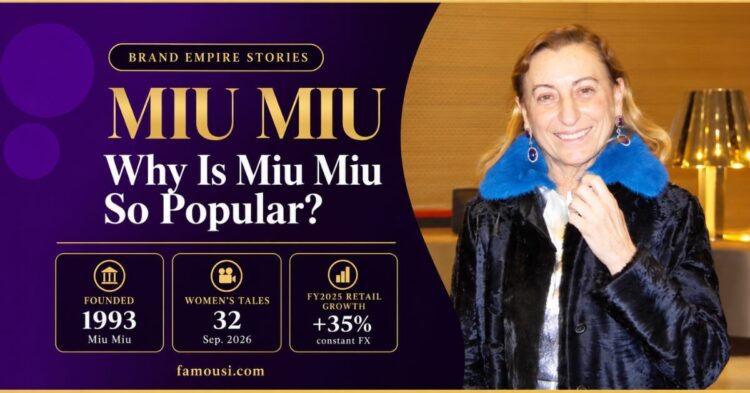
Miu Miu is popular because its current momentum rests on more than a single viral product or fashion cycle. The brand has spent decades building a recognizable identity separate from Prada, pairing that identity with distinctive products, direct retail expansion and cultural projects that keep its point of view visible beyond the runway.
The scale of the recent acceleration is difficult to ignore. Prada Group reported Miu Miu retail growth of 58% in 2023, 93% in 2024 and 35% in 2025, all measured at constant currency. By the first half of 2026, that pace had normalized to about 3% organic growth, but the brand was still drawing strong attention: Lyst ranked Miu Miu No. 2 in Q2 2026, with searches on Lyst up 30% quarter on quarter.
The more useful question, then, is not whether Miu Miu is having a moment. It is how a brand founded in 1993 built enough independence, cultural range and commercial discipline to keep renewing that moment.
The milestones behind Miu Miu’s rise
| Period | What changed | Why it matters |
| 1993 | Miu Miu was founded as an experimental, autonomous expression of Miuccia Prada’s creative vision. | The brand began with a reason to exist beyond simply extending Prada. |
| 2005-06 | Prada Group intensified Miu Miu’s independent positioning; the fashion show moved to Paris in 2006. | Creative identity, commercial organization and distribution became more clearly separated. |
| 2011 | Miu Miu Women’s Tales launched. | The brand created a recurring cultural platform built around female filmmakers and ideas of femininity. |
| 2020 | Miu Miu Upcycled launched with a limited selection of 80 one-off reworked vintage dresses. | Vintage and circular design became part of the brand’s wider cultural language. |
| 2023-25 | Retail growth accelerated from +58% to +93%, then +35% at constant currency. | The cultural visibility was matched by unusually strong commercial momentum. |
| H1 2026 | Retail sales were €763m versus €780m a year earlier, while organic constant-currency growth was about +3%. | Momentum slowed sharply, but remained positive on Prada Group’s organic measure. |
| Q2 2026 | Miu Miu ranked No. 2 in the Lyst Index; searches on Lyst rose 30% quarter on quarter. | Independent platform data still showed high online fashion attention. |
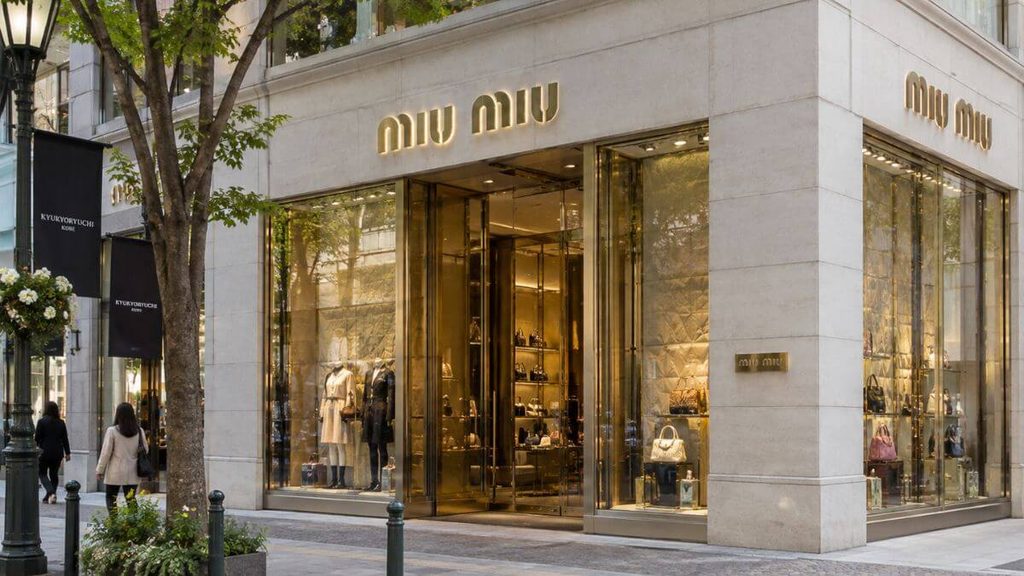
Miu Miu was built to be separate, not simply smaller Prada
Miu Miu’s origin already contained the idea that later became central to its appeal. Prada Group describes the brand as having been born in 1993 from Miuccia Prada’s independent and unconventional spirit. The 2011 Prada IPO prospectus goes further: it says Miu Miu was created with an autonomous identity from Prada, was initially licensed to the Group, and was acquired by the Group in 2003.
That distinction matters because Miu Miu did not become independent by leaving Prada Group. It became independent in brand identity while remaining inside the same corporate group.
The separation became more deliberate from 2005. In its Hong Kong listing prospectus, Prada Group said it moved Miu Miu’s commercial headquarters into a separate Milan building, shifted the fashion shows from Milan to Paris, eliminated the men’s collection to sharpen the brand image and accelerated the directly operated store network. The first Paris fashion show followed in 2006.
That is more than a chronology detail. It shows a brand deliberately creating organizational and cultural distance from a famous parent. Famousi’s story on Prada’s nylon and Re-Nylon evolution explores how the parent house built continuity around one design code; Miu Miu’s story is different because its strength came from making its own contradictions legible.
A recognizable identity gave the brand room to change
Miu Miu has never needed to look like a quieter version of Prada. Its official brand language emphasizes experimentation, contradiction and a deliberately less conventional approach to femininity. Those descriptions are corporate positioning rather than independent proof of popularity, but they help explain why the brand can move between polished, awkward, youthful and subversive references without losing its name recognition.
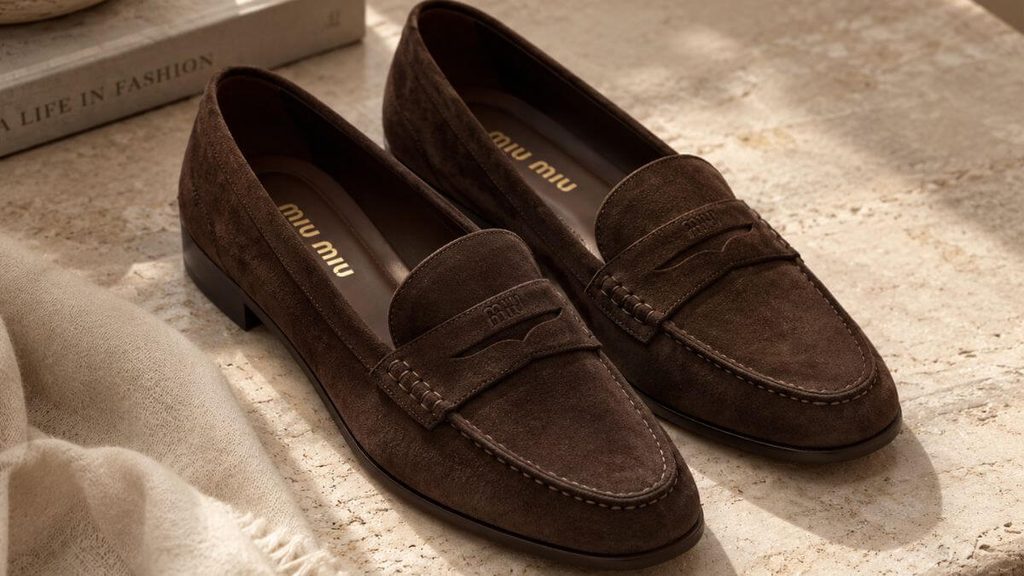
That flexibility matters in fashion because attention changes faster than heritage can. A brand that depends on one silhouette can become trapped by it. Miu Miu instead has a broader aesthetic permission: it can turn a school-uniform reference, a deliberately plain shoe, a jeweled accessory or an archival-looking garment into part of the same conversation.
The evidence does not prove that aesthetic flexibility caused the sales growth. It does show that the brand had an identity strong enough to support repeated product and cultural reinvention while the commercial business expanded.
Culture became part of Miu Miu’s operating language
The clearest long-running example is Miu Miu Women’s Tales. Launched in 2011, the project commissions female filmmakers to create short films around changing ideas of femininity. By September 2026, the series had reached its 32nd commission, Claire Denis’s “Avec Kim.”
The importance of Women’s Tales is not that it can be credited with a specific sales number; public evidence does not establish that. Its value is continuity. A fashion house that commissions films for more than a decade gives audiences another way to encounter the brand’s worldview between product launches.
A similar pattern appears in Miu Miu Upcycled. The project launched in 2020 with a tightly limited selection of 80 one-off, numbered vintage dresses reworked by Miu Miu. Later editions extended the idea into other materials and collaborations. Again, the useful point is not to claim that circular design explains Miu Miu’s growth. It is that the brand repeatedly turns product into a wider cultural proposition.
The commercial acceleration was real—and unusually steep
The recent financial record makes the popularity question harder to dismiss as fashion-media noise. In Prada Group’s 2023 full-year results, Miu Miu retail sales grew 58% year on year at constant currency. In 2024, growth accelerated to 93%.
The comparison became much harder in 2025, yet Prada Group still reported 35% Miu Miu retail growth for the year and 20% in the fourth quarter. Those figures are company-reported retail-growth measures at constant currency; they should not be confused with market share or an independent measure of brand popularity.
The first half of 2026 is the useful reality check. Reported Miu Miu retail sales were €763 million, compared with €780 million in H1 2025. But Prada Group’s H1 2026 results show roughly 3% organic growth at constant currency. In other words, the explosive pace cooled, but the company’s like-for-like organic measure remained positive against a very demanding comparison base.
That slowdown is important because it prevents a misleading “straight-line growth” story. Miu Miu entered 2026 from an unusually elevated base; continued relevance now has to be judged by whether the brand can sustain attention and full-price demand after the surge, not by whether every quarter repeats 2024’s extraordinary rate.
Independent demand signals still show strong attention
Financial results tell us what Prada Group sold through its retail network. They do not tell us exactly how much cultural attention Miu Miu commands outside the company. That is where independent signals are useful—provided their limits are clear.
In Q2 2026, the Lyst Index ranked Miu Miu second among its hottest brands, up two positions, after searches on Lyst rose 30% quarter on quarter. Lyst says its methodology combines activity from its own shopping platform with social, search, editorial and emerging AI-discovery signals.
That makes the result useful as an online fashion-attention indicator, but not as Google search volume, worldwide market share or proof that every customer segment is moving in the same direction. The strength of the signal is that it comes from outside Prada Group and still points to substantial current interest.
So, why is Miu Miu so popular right now?
The strongest explanation is cumulative. Miu Miu began with a distinct creative premise, then Prada Group gave that premise more organizational independence. The brand built cultural platforms that could carry its worldview beyond seasonal collections. At the same time, it expanded a direct retail system capable of converting attention into sales.
None of those elements, on its own, proves why a particular customer bought a shoe, bag or jacket. Together, however, they explain why Miu Miu can generate both recognition and surprise—two qualities that rarely coexist for long in fashion.
The 2023-25 growth figures show that this was not merely a media narrative. The H1 2026 normalization shows the limits of the boom. And the Q2 2026 Lyst ranking shows that even as the growth rate cooled, online fashion interest remained high.
Frequently Asked Questions
Who founded Miu Miu, and when?
Miu Miu was founded in 1993 from Miuccia Prada’s creative vision. Prada Group’s current brand history and its 2025 annual report both use 1993 as the founding year.
Is Miu Miu owned by Prada?
Miu Miu is a Prada Group brand. Historically, the brand was first licensed to the Group by Miuccia Prada and was acquired by the Group in 2003. Its brand identity is intentionally distinct from Prada even though the two sit inside the same corporate group.
Why is Miu Miu so popular right now?
Miu Miu’s current popularity is best explained as a combination of a distinctive brand identity, sustained cultural visibility, product and retail execution, and strong recent commercial momentum. No public source proves that one campaign, platform or product alone caused the growth, so a single-factor explanation would go beyond the evidence.
How fast has Miu Miu grown in recent years?
Prada Group reported Miu Miu retail growth of 58% in 2023, 93% in 2024 and 35% in 2025, measured at constant currency. In H1 2026, organic constant-currency growth slowed to about 3%, while the reported euro value of retail sales was €763 million versus €780 million in H1 2025.
What is Miu Miu Women’s Tales?
Miu Miu Women’s Tales is a female-led short-film commissioning platform launched in 2011. By September 2026, it had reached its 32nd commission. The project is important to Miu Miu’s cultural identity, but public evidence does not establish a direct causal link between the film series and the brand’s sales growth.
Miu Miu’s advantage is not one viral moment
Miu Miu’s rise is more convincing when it is read as a system rather than a trend. The brand’s 1993 origin gave it a distinct reason to exist; the 2005-06 repositioning made that independence more operational; long-running cultural projects widened the world around the products; and the 2023-25 retail surge showed that the story could translate into commercial scale.
The harder test begins after the surge. H1 2026 already shows a slower growth environment. But with Miu Miu still ranking near the top of Lyst’s Q2 2026 index, the evidence so far suggests that the brand’s relevance is broader than one exceptional sales year. Readers interested in similar brand-building stories can explore more Brand Empire Stories on Famousi.